Tuesday, April 23, 2013

Goodbye Cape Town // Hello Christchurch, NZ

After many delays, side-trips and attempts to prolong my time in Cape Town, I've finally shipped off from South Africa and moved on to WATSON PHASE IV: NEW ZEALAND. I've been in Christchurch for four days now, and have already settled in and established myself and my project in ways that usually take a few weeks of Watson-time. Within 36 hours of arrival, I had already:

1.     Settled into a homey place to stay with three wonderful housemates
2.     Figured out public transit and found a bike to use (thanks wonderful housemates)
3.     Received an office with desk space and computer from the University of Canterbury's astronomy department
4.     Played ultimate frisbee
5.     Recovered from ten hours of jet-lag (almost)
6.     Spoken with students about outer space!

All in all, I'm quite proud of myself. There have been times when I've kicked myself for delaying my trip to NZ -- I was originally supposed to arrive in late February!-- but I know that the other trips I've taken have been well worth the delay, and also that the resources and accessibility here, combined with my experience traveling, will make it possible to get the most out of a shorter amount of time.

But I think I'm getting ahead of myself. My last few days in Cape Town were perfect. Although I had a lot to do in terms of wrapping things up and getting ready to leave, the sun was shining in that ideal early-autumn way, and there was still time for adventures and saying goodbye properly.


I forgot to mention in my last post that I had my birthday on my last day in Ethiopia. I celebrated by going to two schools and chatting with students about astronomy, and having huge, traditional, delicious meals with both The Ethiopian Space Science Society and Birukti & co. It was an ideal way to celebrate my 23rd journey around the Sun. Plus, messages through email and facebook poured in from around the world, and I felt absolutely loved from all directions.
My birthday lunch with the ESSS in Ethiopia
When I got back to Cape Town, though, I did have a small casual get together both for another excuse to eat cake and a chance to say goodbye.
Birthday cake, food and friends in the park for a final get-together
We also had time for one last OAD-family hike up Table Mountain. Seeing the city from above at all angles was the perfect way to say goodbye to this beautiful city/country that has taught me so much.
 
Final climb up Table Mountain
On my last day in South Africa, I was able to squeeze in one final chat with students. SHAWCO is a non-profit organization run by the University of Cape Town that does a number of outreach projects in the community. My friend Ru runs one of the education projects, which tutors high school students and also helps the students organize independent research projects. Some of the groups are doing projects on science (one in particular on space science), and so I came in and spoke with them about astronomy and all that South Africa had to offer. Even though the project is huge, most of the students had not previously heard about the SKA and what it's going to bring to SA. It was great to hear their ideas about astronomy and also to see them get excited for the projects that are being developed in their country. 
 
Final chat with South African students

And then it was off to New Zealand! 36 hours, three stops, and ten time-zones later, I was in Christchurch. While the journey was exhausting, I will say this about long flights -- having a window seat gives astronomical perspective. In those 36 hours, I saw two sunrises, two sunsets, and the crescent moon go from the left side to the bottom as we neared the equator, and back to the left as we returned back to the Southern Hemisphere. 
Sunset after Capet Town take-off (crescent moon still on the left)
I arrived in Christchurch in the early afternoon, and by the evening, I was speaking with students from the AURORA school -- a one-week camp for high school students interested in astronomy. They had just returned from a [cloudy] trip the Mt John Observatory, and the leaders of the camp were running a fun Astro-Quiz night. I hung out with the group, and heard about the things they had enjoyed learning during the camp. Topics ranged from exoplanet detection to dark matter candidates to telescope operations. The students are all in their final year of high school, and it seemed that many of them became more interested in studying astronomy in college (or "Uni" as they say here), because of the AURORA school.

AURORA school students showing off their clay-model telescopes at Astro-Quiz night
The University of Canterbury astronomy faculty, who ran the AURORA school, has since welcomed me into the department as a visitor, and has provided me with office, desk and computer. I'll be working with them here on campus and also with teaching fellow Ben McNabb, who will help me organize visits to primary and secondary schools around Christchurch. 

Since settling in, I hoped to explore town a little bit more, but since the weather has been cold, rainy and miserable, I've mostly kept indoors. On Sunday, it was raining and sad, so I spent the afternoon at my local public library, only a 5 minute bike-ride away. I thought I'd go for the computers or to find a nice novel to read, but I found myself instead in the children's section, in a tiny chair, covered in children's books about outer space. The most interesting books were Maori legends that explained how the Sun, Earth, Moon and stars came into being.
 
Rainy day at the Papanui public library, reading children's books of Maori astro-legends


I'm here in New Zealand to explore this intersection between access to a high-achieving public education system (NZ ranks 4th in reading and science and 7th in math globally), and a strong traditional astronomical culture. Reading these legends was fascinating, and also gave some insight into how children in NZ are learning about astronomy. 

This week, I'm settling into life here, getting adjusted and getting some practical things done (like blogging!). These next two weeks are school holidays, proving that I am absolutely the worst at timing my travels so that I'll be able to speak with kids in schools (Chilean independence, Dasain in Nepal, Christmas/New Years in South Africa...) I don't think this holiday will inhibit my activities too much, though, as next week I'll travel to visit the South Canterbury Astronomical Society in Geraldine and Timaru to take part in their Global Astronomy Month events, and also hopefully take a trip to the Mt John Observatory near Lake Tekapo. 

---

UPDATE since the first part of this post was written -- the skies have finally cleared, and the weather report is now calling for "mild temperatures and abundant sunshine" for the next few days. Visions of gorgeous Christchurch autumn:
 
View from my 8th floor office (see mountains in background)
Campus walkways. I can't help but think of the Haverford nature trail in October

Monday, April 15, 2013

Ethiopia

I'm back in Cape Town now for a few days after a very quick, but very meaningful and informative trip to Ethiopia. In each of the places I've gone on this project I've had time to fully immerse myself not just in the educational or astronomical culture, but also a bit in the national culture, the language, the local histories, the arrangement of the cities and so on. By spending 2.5 weeks in Ethiopia, instead of my standard 2-3 months, I didn't necessarily have time to do this, and instead was on *Watson Power Mode*, attempting to absorb and do as much as humanly possible in the short time I had. 

I chose to go to Ethiopia because astronomy is rapidly developing there at the professional level. The Ethiopian Space Science Society (ESSS), which is based at the Department of Technology at the University of Addis Ababa, is currently in the process of building a professional-class observatory with two 1-meter diameter telescopes in the mountains just above Addis. They're also beginning site testing for another observatory in the north of the country, in the more remote hills of Lalibela. In visiting Ethiopia, I wanted to see how this development is affecting students, if at all. Simultaneously, I wanted to explore how other aspects of Ethiopian culture, including religion, affect children's notions of the Universe.

Through my work at the OAD in Cape Town, I was able to connect with the ESSS ahead of time and through them, I visited 5 different schools across Addis in the time I was there. We visited both public and private schools, although each of the schools we visited had their own Space Science Club. Besides these clubs, astronomy is barely in the school curriculum, usually taught as small units in physics or geography classes. For the most part, I gave my standard presentation and engaged with students directly this way.

Speaking to the Nazareth girls school Space Science Club.
Nazareth girls school, student organized Space Science Club evening event, complete with  star gazing
Misrak Goeh Secondary School Astrophysics club
St. Joseph School Space Science Club
These space science club meetings usually included student presentations on topics ranging from the basics of the Solar System to traditional Ethiopian astronomy to the possibility of life on Mars. Each student presentation was highly researched, and you could see the personal interest these students had in the subject matter. Some of the students (especially in the private schools) had extremely high-level questions, some of which I couldn't answer. It seems that these students are getting their information from the internet, or Discovery-channel type TV programs, as schools don't cover these topics at all. 

Advanced Q&A session at the St. Joseph School. In my first visit to St. Joseph, the students thought my presentation was "elementary," and they requested an advanced Q&A session where they could ask high-level questions. This panel of astrophysicists couldn't even answer all of their questions regarding anti-matter, string theory, white holes, and the standard model of cosmology.
Student presentation on the life cycle of stars, Nazareth Girls School

With the ESSS, I visited the site of the Entoto Observatory, just 30km away from Addis Ababa. Despite the proximity to the city, the light pollution is fairly low and because of the high altitude, it is less rainy than in the city. When I visited, the spaces for the two domes were being constructed, and the buildings for offices, cafeteria and accommodation were nearly complete. Over the course of my visit, the domes were delivered, and in the months ahead the telescopes themselves will be shipped and installed.
Construction of the Entoto Observatory
Construction of the Entoto Observatory.
Main Observatory building for offices, cafeteria and accommodation.
Probably the highlight of my time in Addis was couch surfing with Birukti, an inspiring young woman who has facilitated numerous outreach projects in Addis through the support of her church. She generously agreed to host me for my entire visit and helped me to engage with Addis life as much as possible in the little time I had.

With Birukti in front of Wenchi Crater Lake
Because work on the Observatory was busy during my visit, and because the ESSS members work only on a volunteer basis, my school visits with the ESSS only happened on a few days. With Birukti's help, I spent the remainder of my time exploring Addis Ababa and a bit outside the city, and engaging with kids in different settings besides in schools.

About five years ago, Birukti started a house for teenage boys who had formerly lived on the street. The project, called "Change House," had a total of 22 boys to start, many of which have graduated and are working and self-sufficient. With Birukti, I visited the house, which has 4 boys living there now. The following night, the boys, plus a few of the graduates, came over to Birukti's house for dinner, games and a little bit of telescope time.  The clouds rolled in before we could see anything too cool, but it was nice that they still got to see how the telescope worked.

At Birukti's with the Change House boys
Looking through the telescope before the clouds roll in.
Birukti also organized a program for girls she works with in the Entoto mountains to do a quick lesson on astronomy. We went over the basics of the Sun, Earth and Moon system, and explained orbits, seasons and lunar phases. 
Birukti translating for our lesson about the Sun, Earth and Moon
Learning about Earth's tilt.
Even though I didn't have time to explore a wide variety of educational settings and speak with tons of kids, I do feel that I did a lot given my short time there. I am grateful for the opportunity to see a completely different country which functions very differently from any place I've been. Special thanks to the ESSS for facilitating my project and to Birukti for hosting me!

Tomorrow I head to NEW ZEALAND for phase 4 (or 5?) of my trip. I'm sad to leave what has become my family and my home in Cape Town, but I feel ready for more adventures and a new place to explore.

To close, more pictures from Ethiopia:
Huge Orthodox Christian church in Bole, Addis Ababa
Sunset from Birukti's house. The sky, I think, was Addis' most beautiful quality.
View of Addis Ababa from halfway up the Entoto mountains
Wenchi Crater lake
First time on a horse! Wenchi Crater 
Amazing sunset from the plane

Saturday, March 23, 2013

Little Maya and the Big Radio Telescope: Day Trip to Carnarvon

A quick and frantic post while taking a break from packing/attempting to eat the remaining contents of my refrigerator since I'm leaving for Ethiopia in apprx 13 hours (!!!)

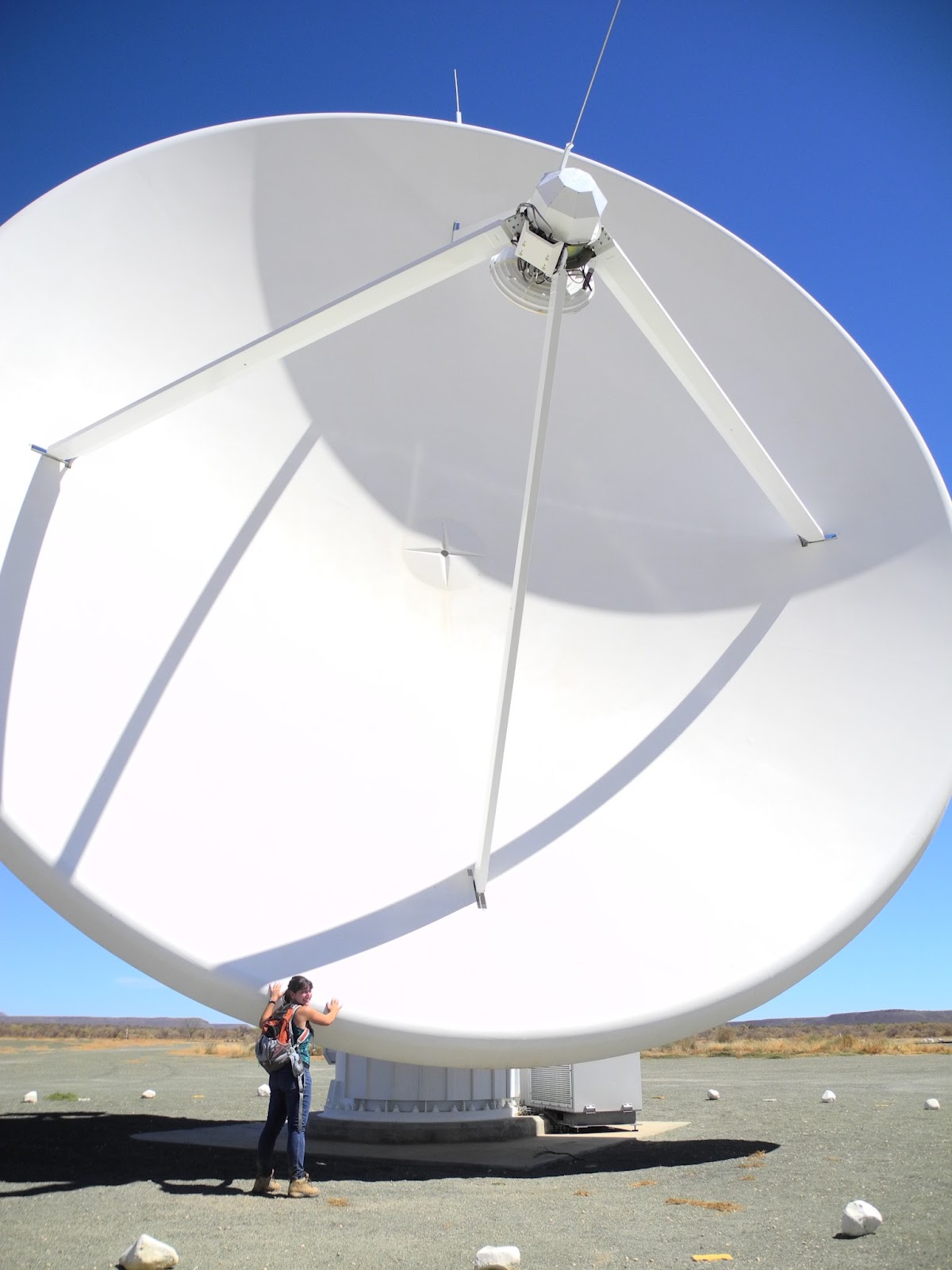
This week, I had the special opportunity to visit Carnarvon in the Northern Cape, which is home to the main site of the Square Kilometre Array (SKA), soon-to-be largest radio telescope in the world. Right now, the site is only home to KAT-7, the seven-dish precursor to MeerKAT, which will consist of 50+ dishes and be the pilot project for the 1000+ (yes, not a typo -- ONE THOUSAND) SKA dishes to come over the next decade or so. In total, the SKA will have 3000+ dishes, and span two continents, making it the most sensitive and powerful telescope on the globe.

In summary: Big Science to happen here SOON.


Five of the seven KAT-7 dishes 
At SciFest last week, I met Dr. Nadeem Oozeer, Operations and Commissioning Scientist for the SKA, and he offered to show JC (new project director of the OAD) and I around the SKA site. Nadeem organized for us to fly to Carnarvon and back on the same day with the special SKA 8-passenger plane, and so we were able to see this fairly remote place in the Karoo without having to make a huge trip.
JC and Nadeem at the top of the hill above the KAT-7
Tiny plane we took to Carnavron! Felt like a celebrity.

It was awesome! Again, I felt like I was meeting a celebrity when I saw the KAT-7 dishes. It's wonderful to think of all of the incredible science that will come out of this place in the years ahead. I also hope/expect that, as with SALT in Sutherland, the SKA will work to contribute to the community of Carnavron. It will be cool to come back in a few years and see what it's like!
Giving one of the KAT-7 dishes some love

Many many thanks to Nadeem for taking the time to show us around the site and organizing our trip up! 

Monday, March 18, 2013

SciFest Africa 2013

Last week I tagged along with the SAAO and the OAD to SciFest Africa, South Africa's National Science Festival, in Grahamstown, Eastern Cape. The festival hosts thousands and thousands of kids, mostly from the surrounding areas, but also from all over the country. SciFest holds workshops, lectures, exhibits, performances, games and competitions, all related to science, mathematics and technology.

The first thing I can say about SciFest is that it was really fun. Students were ready and excited to engage, and the educators had tons of energy and were incredibly inspiring. Combine this with some really cool science, and the end result was a huge smile on my face all week long.

Here are some of the highlights:

1. The SAAO exhibit. Students would pass by casually or visit in groups, and with the iPads, we explored different planets, constellations, played astronomy games and the kids took the national astronomy quiz to test their knowledge. This was the place where I could engage with kids most and ask questions to understand their ideas about astronomy.
SAAO exhibit
2. Laser show at 9:30am. I actually went twice. It was a great way to get kids (and adults) pumped up for the festival.


3. SAAO workshops on building telescopes and describing the motions of the Solar System. I liked that the students had something to take away with them at the end of the workshop to remind themselves of the things they created and learned.

SAAO telescope-building workshop
4. Trip to Alexandria Primary school ~1hour away. Part of SciFest is not just hosting students in the facilities in Grahamstown, but also doing outreach in the surrounding area. Several of us tagged along to see Steve Sherman from the Living Maths program at the Cape Town Science Centre do his exciting routine to get kids engaged with mathematics.
Steve Sherman from Living Maths doing a brain teaser exercise with students from Alexandria Primary School

OAD director Kevin Govender inspiring young minds at Alexandria Primary School
5. Talk by special guest Prof. James Gates from the University of Maryland. Dr. Gates is known for his work in string theory and now serves on President Barack Obama's Council of Advisers on Science and Technology. Several years ago, however, when his children attended my alma mater, he spoke several times to my high school physics classes about being a scientist. Several years later, he visited to Haverford to speak about his work in string theory. So this was my fourth or fifth time hearing Dr. Gates, and it was great to hear how his research has progressed over the years. It was also cool to reflect on how my own relationship to science has been extremely different every time I've heard him speak. (I'm kicking myself now because I didn't ask for a picture!)

6. Making friends with other wonderful astronomy educators. It became immediately apparent that SciFest is not just an annual festival, but the meeting of a huge network of science educators that function more as a family than a group of colleagues. I feel so grateful to be welcome into that family for the short time I was there.
With a group of other science educators in front of the local Grahamstown hangout
7. Road trip back to Cape Town with the OAD gang. 10+ hours from Grahamstown to Cape Town with OAD director Kevin Govender and project officer J.C. Mauduit, chatting about astronomy, development, learning and life, with some great stops along the way.
The road trip gang above Storms River
In front of the tallest bungee bridge in the world. Again, no way would I jump, but it was cool seeing others do it!
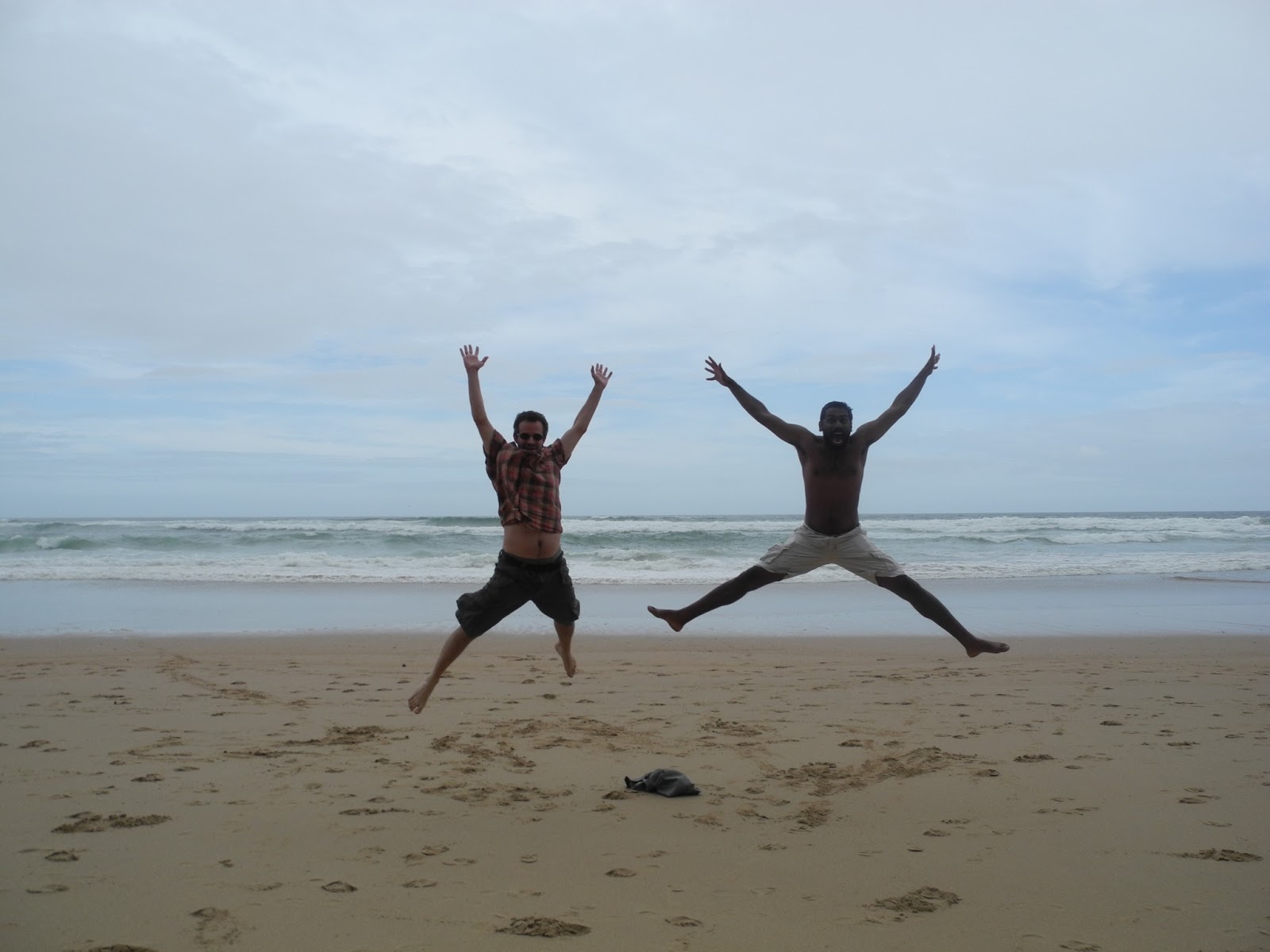
One of many jumping pictures. Wilderness, Western Cape
Almost home, welcomed by the Western Cape sunset
Now I'm back in Cape Town for a week and then I'm off to Ethiopia! It's going to be tough to say goodbye to this place and the fantastic group of people that have made my experience here so meaningful. 

Thursday, March 7, 2013

South Africa Cross-Country Trip Part II

[See Part I for tales of the first stage of this journey. This is going to be a long post, with a lot of info and not as many pictures as I would have liked. Apologies.] 

The second part of my trip differed from the first in that I went from creating my own schedule and methods of outreach to visiting many established centers of astronomy and science education. With Case's philosophy in mind about going back to the basics for effective science education, I kept a running total of places where technology obviously made a huge impact, and places where great amounts of learning occurred without the help of modern technology.

Stop 5: Durban (but really, just Gateway Mall)
I planned to be in Durban for a few days, but as other plans developed and as my time became more and more limited, I decided I had to cut my time in Durban down to a mere 24 hours, just enough time to see the fabulous KZN Science Center

The center is located in Gateway Mall, supposedly the largest mall in South Africa. It's an interesting location for a science center, as they're able to make science education an option for people who might not be seeking it independently. Parents can drop off their kids to play and learn while they go and do their shopping in peace, for example. In addition to reaching the general public this way, the science center also regularly hosts school groups and has a team that brings materials and activities out to rural areas.

When I visited the center, there were no school groups scheduled, and the staff was generous enough to take me through their astronomy program. The program is still in its developmental stages, and it was cool to see what they were building and also offer some feedback based on my own experiences. The center has labs and classrooms in addition to an open area for exhibits, so there are a variety of ways to engage with students. They also have an inflatable planetarium with a pre-recorded show (created by NASA, by the way) which they sometimes take out into the mall for public outreach and advertisement. Technology: 1, Basics: 0. 

Just like when I visited the Cape Town Science Center, I was again reminded how much I love these kinds of "informal education" settings. Having the space to play while still learning science and critical thinking skills is something essential that these spaces offer and classrooms often cannot.

Stops 6(a, b, c): "The Fishbowl" in Mtunzini, Unizul Science Center in Richards Bay & Sibusiso Esihle Science Centre in Mvelabusha

Part of my reason for leaving Durban early was because I was offered a ride to and a place to stay by Derek Fish, director of the Unizul Science Center in Richards Bay. He and his family were generous enough to host me for 4 days in Mtunzini, just south of Richards Bay, at their home, known best by guests as "the Fishbowl."

Derek is often described as the "heart" or the "king" of South African science centers. After seeing his center in Richards Bay, its clear why. The Unizul Science Center is unlike others in that it is only for school groups and does not generate its income from the general public. Beyond hosting school groups during the day, the center additionally does school visits, and offers workshops for students studying for their high school graduation exams. 

Unizul Science Center, Richards Bay
Building an an annalemic sundial at a nearby school in Richards Bay with Unizul Science Center Staff
The science center runs on a very small budget, mostly supplied by the University of Zululand (Unizul), and Derek is using that budget to create resources for the greatest number of children possible. He said to me, "If I had an option of creating a good, high-tech activity for one kid or a more cost effective activity for 10 kids, I would choose the second one every time." With this mentality, you can see where the success of this center comes from. Many things in the center are made from recycled goods and many exhibits are "hand-me-downs" from larger centers around the world. While this means that the exhibits look a bit run-down, or "well-loved," kids don't seem to notice or care. +1 for Basics. Technology: 1, Basics: 1.

Some science centers find their success from huge budgets and large floor space (see my experience in Johannesburg below), but this one thrives without those things. What makes this center is not computer screens or flashy interactive video games or shiny new exhibits, but instead people like Derek who bring science to life. And you can see that it works. Watching these kids enjoy the science show and being led through the activities on the floor, you could tell that they were learning and simultaneously having a great time. 

The next day, I went with Derek to Mvelabusha, a very rural area several hours north of Richards Bay, that was celebrating the grand opening of the Sibusiso Esihle Science Center. The Science Center was small -- just a single room converted from the town's old tavern -- but was filled with potential. For now, they're borrowing exhibits from the South African Agency for Science and Technology Advancement, but hopefully more permanent exhibits can be purchased soon. 

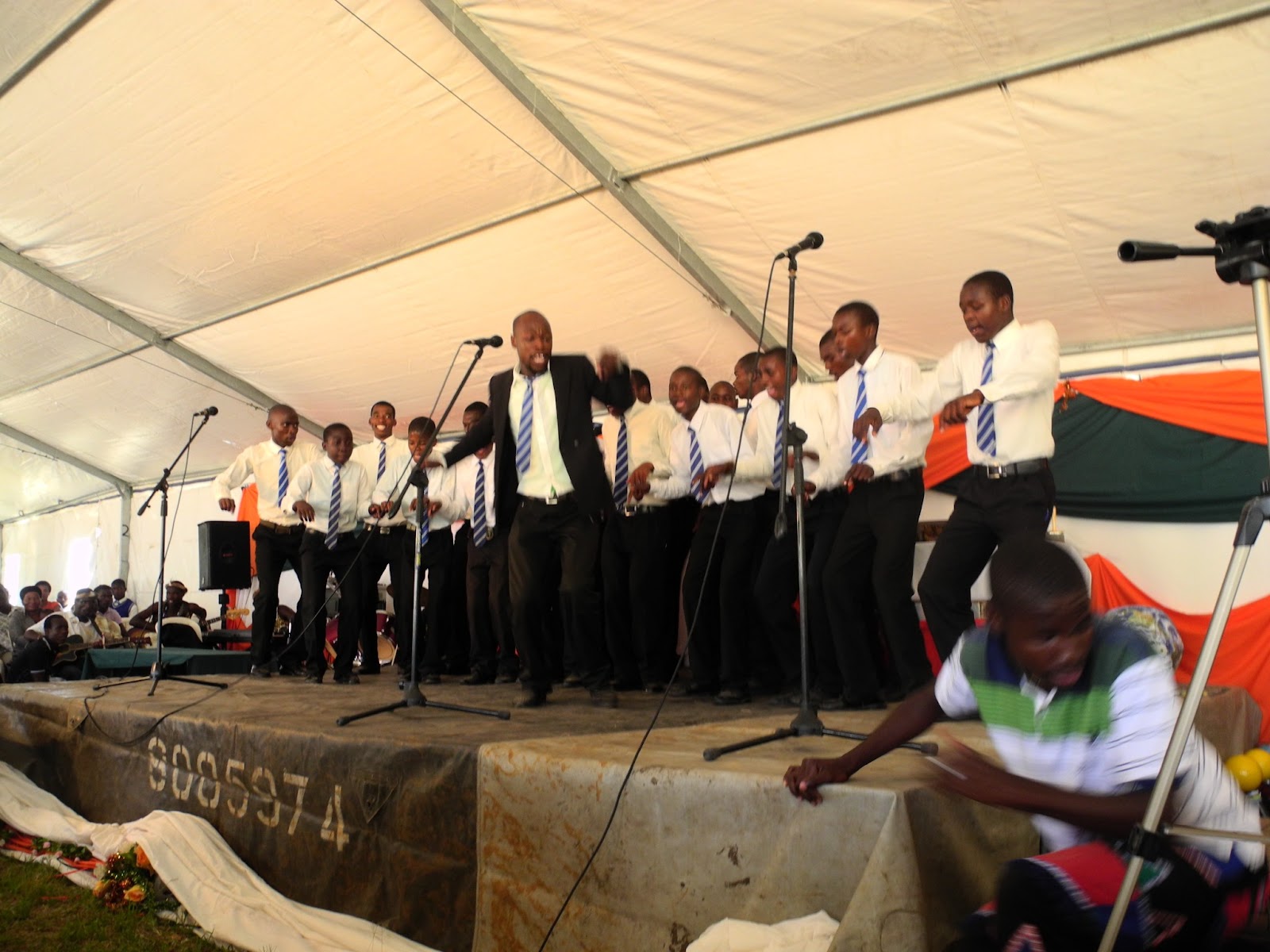
The opening event attracted local government officials, educators, and students from over a dozen nearby schools. The event included numerous speeches, performances by school groups, Derek's famous science show on the physics of sound, and even a talk by a REAL AMERICAN ASTRONOMER (me, incidentally). 
High school boys choir performing at the opening of the Sibusiso Esihle Science Center in Mvelabusha
Student dance performance
Science show by Derek Fish on the physics of sound, translated into Zulu
A talk by an American astronomer (me), translated into Zulu
Again, while this center didn't have too much in the way of material goods, you could tell that the heart and dedication of the people there will be what makes this space thrive as an educational and inspirational space.  +1 for Basics. Technology:1, Basics: 2.

The rest of the weekend was spent with the Fish family, who generously showed me around the lovely Mtunzini beaches and nearby forests. It was a wonderful weekend, and I am so grateful for their hospitality!

Thank you to the Fish family for hosting me in Mtunzini!
Stop 7: Johannesburg, etc.
I spent my final few days of this trip in Johannesburg, described to me either as a"big, bad, dirty city" or as "the greatest city on Earth." I don't think I was there long enough to make a clear judgement either way, but I was able to see most of what they have to offer in terms of science education. Most of my activities were organized by the science awareness sector of SAASTA (South African Agency for Science and Technology Advancement), based at the Johannesburg Observatory. 

The first day, we took a trip out to Hammanskraal, a rural community several hours away from Jo'burg. We arrived late, preventing us from doing a full program, but I did have the chance to have conversations with students about astronomy. While the students were enthusiastic to chat about astronomy, their prior knowledge was practically nonexistent. Even though they were in grades 11 and 12, they often described stars as "fixed points of light in the sky, only created at night" and planets as "the layers protecting Earth" or "where life exists." One student, when asked how many moons the Earth had, said "About 6? Full, half, crescent..." So while they're making observations about the Universe, they have not received formal education on, nor been pushed to think critically about astronomy.

The presence of the inflatable planetarium and later on the telescopes for our star party attracted hoards and hoards of people from the community. While they might not have had any previous knowledge about the object we showed them, the community members were still enthralled by the experience of looking though the telescope. In this way, the technology itself was the attraction and the inspiration.  +1 for Technology. Technology: 2, Basics: 2.
Star party with the Hamanskraal community (it's hard to take out a camera without  teenagers wanting to pose)
The following day, we went to Science Unlimited, a three-day science festival in Johannesburg. I was only there for a few hours, and there weren't very many astronomy-related exhibits, but it was still interesting to see how kids were responding to the science shows, lectures and exhibits. Basic puzzles and science projects were enough to unite students from different schools and have them collaborate to solve science problems together. No screens needed.  +1 for Basics. Technology: 2, Basics: 3.
Science Unlimited festival , Johannesburg
Science Unlimited festival, Johannesburg
In my last full day in Jo'burg, I visited the Johannesburg Planetarium, which was hosting a school group for an interactive lesson. During the show, they used the technological capabilities of the Planetarium to explain scale sizes, seasons and space travel in ways that were easily digestible while still being scientifically correct. 
Johannesburg Planetarium

This year, I have been confronted with several examples of poorly-taught astronomy, most commonly related to scale size. Because the Solar System is so big, and so full of empty space, it's easy to discount scale size when teaching astronomy. There are countless bad examples and only a few good examples that show scale size well. Distances to scale are even more difficult to explain. What I liked about the Planetarium was the ability to show both size and distance to scale correctly so that kids could fully grasp these concepts. +1 for Technology. Technology: 3, Basics: 3.

After the Planetarium, I spent the afternoon at the SciBono Science Center, which was perhaps the complete and polar opposite of Unizul. Everything in the 5-story science center was brand new, shiny and often electronic. There were tons of interactive games ranging in topics from gravity on other planets to the science of soccer.  I can't lie, it was awesome. Transporting virtually into outer space or pretending to fly a fighter jet were really fun, while still being educational. +1 for Technology. Technology: 4, Basics: 3But without any concrete evidence, its hard to say if kids actually learn more or learn better with the help of technology like this. 

SciBono Science Ccenter , Johannesburg

In the flight simulator at the SciBono Science Center, Johannesburg
Final count: Basics: 3 , Technology: 4. But considering the fact that spending less money is always better, this adds 1 to Basics and making the REAL final score a tie at Basics: 3, Technology: 4. This leaves me utterly undecided on the issue.  Feedback/opinions welcome -- I'd be interested to know what people think. 

What's up next: a little more time in Cape Town, SciFest in Grahamstown, and then off to ETHIOPIA later on in March!