Tuesday, November 19, 2013

IOAA Full Interview with Team India

Here, finally, is my full interview at the IOAA with the Indian team (Arindam Bhattacharya, 16, Ashutosh Satyajit Marwah, 18, Ayush Kumar, 16, Sandesh Kalantre, 17, and Sheshansh Agrawal, 16). This is long overdue, but the interview was so moving and the students were so articulate, I had to keep my promise to post it. I've underlined some especially memorable quotes.

* * * * * * *

The selection process to qualify to represent India in the IOAA is quite an intense one. Could you describe it?
Ayush: There are three stages. In the first, 15,000 students take a multiple choice exam. Then it's narrowed to 300 for a second exam. In the third round, 35 students are invited to a 20-day camp. 

Wow. What is that camp like? It sounds like Astrophysics boot-camp.
 
Ayush: To be honest, the camp is very rigorous. We get very little sleep during the camp. They teach us whatever they test us on. Based on how we preform on the test, that’s how they select the [final] team.

That's a lot of extra work and time outside of school to enter in the IOAA. What motivated you to go through with it?
 
Arindam: Firstly, I’d like to mention that the camp is not just an academic camp. There is a fun element to it. We have late-night sessions of sky observations where people who don’t have any first-time information about telescopes get to learn to use it. And we get to observe the actual objects that we usually see in picture-books or encyclopedias. But we also play a lot of games. It’s a chance to meet new people -- to meet like-minded people -- from around the country. We also get to learn from some of the best professors of astronomy in India. 

Sandesh: The thing about camp is that we also have past national medalists that help to teach during the camp. They help to make the camp more fun. They are co-facilitators of the camp and help to design the papers and also play games with us. So the camp is not just an academic experience but also a fun one.

Ayush: Who doesn’t want a 20-day vacation? It’s just like a vacation.

Sure, but some people see vacation as sleeping in and laying on a beach. Not doing hardcore astrophysics.

Ayush: We’re not just some people, are we?

Fair enough. How long have you been interested in astronomy? What got you interested?

Ashutosh: Six months. That was when I was selected for the second round. I was more interested in physics and maths and that’s why I got selected. Physics and maths has brought me here. 

Sheshansh: Astronomy comes in bits and pieces in a child’s life when parents of a child tell him the mythology of the stars. A child becomes curious when they wonder how something in the sky can be associated with myths. That’s a minor part of how I got into astronomy. But the major part was last year when I got selected for the third stage of the selection camp. When the teachers sent me the preparation CD and textbooks, I started reading them, and there was something attractive in them. It’s all about imagination. That’s the best part of it that’s in astronomy and nowhere else.

Arindam: Astronomy as a subject is not taught in Indian schools. I originally got interested in the subject when I got selected for the astronomy camp in India. The best part of astronomy that appeals to be is that the main theme is unification. Astronomy is one of those subjects that connects the celestial to the terrestrial.

Sandesh: The thing I love about astronomy is observation. When I was small, maybe 7 or 8 years old, I first saw through a telescope Saturn’s rings. That was the moment I thought that I should take astronomy because you know there are so many beautiful objects in the sky, and we miss them without a telescope. Astronomy is a medium which provides me that facility, so I love it.

Ayush: The first thing is that I’ve loved science since I was a kid -- that’s not the question. How I got into astronomy -- In physics you have an experiment. You say how can I do this, let’s see what happens, how can I judge the outcomes and make predictions. But in astronomy the experiment is always going on. You cannot change anything. You just have to observe whatever it is that nature provides you with. The most interesting thing is that all of the information you have is just a ray of light. A ray of light enables you to know the atmosphere of a planet thousands of light-years away from you as well as we know the atmosphere of our own planet. That’s what amazes me. Just a little bit of data and you can get a lot of information.

What resources are available to learn astronomy? Do you have clubs in your schools? Do any of you have access to telescopes?

Sheshansh: As far as studying astronomy goes, last year I bought a telescope -- a Newtonian reflector telescope -- and I use it to observe the sky. As far as books and knowledge is concerned, I guess the internet is huge enough.

What do you think of this years Olympiad so far? (Four of the five students had participated in previous Olympiads.)

Ayush: We’ll see what happens. There are a lot of fun people around. There are some people who study all day, but also people who like to have fun.

Ashutosh: Good things: We got to know a lot of new people. Also the beach is excellent. Volos is a great city, and the city looks great from Mount Pelion...

I would still like to hear more about your motivation. Where I come from, it takes a lot to motivate students academically, especially if extra time outside of school is needed. Where does your drive for astronomy come from? 

Ayush: Sportsmanship. Why does a sportsman live? I’ve never felt that there’s any real difference between an academic Olympian and an athletic one. It’s the same feeling. In football, you have struck for the goal and there’s this moment where you are waiting while the ball is in the air, and you don’t know if it will go inside or outside or if the goalkeeper will stop it, and there is this thrill. There is the same thrill here. You’ve written an exam, you’re waiting for the results. It’s exciting. And for any sport you need to prepare a lot. You sweat, the hard work is there... So what drives us? The game, the sportsmanship.

Ashutosh: What Ayush wants to say is that all of this, all of the preparation, it’s worth it. It’s completely worth it. It’s a chance to represent India. It’s a great thing. We get to represent our country. We have blazers that say “India” on them, which is pretty cool, and yes, I love solving new problems. Sometimes we get to make new problems before our tests so we can test each other. It’s just fun to solve problems. I’d say the same for [my team].

Ayush: It’s like going on an adventure. That’s what it is for me. We don’t know what is going to happen. We don’t know what obstacles we will face. We’re just out here, with all the preparation you can possibly have, and it’s pretty exciting. We're living these 7 days to the fullest.

What would you say to students your age who aren't motivated to learn?

Ashutosh: I guess everyone should learn what they like. That’s what we’re doing. We like astronomy and physics, so that’s what we’re doing. Everyone likes something at some stage in their life, that’s what they should do. Set goals, work towards them, and achieve them.

What would you say to a student who is passionate about something but feels stuck?

Ashutosh: I have no background in astronomy. I just liked it. I had this book that my father bought for me with all of the cool Hubble photos of the galaxies and nebulae. If I can do this, anyone can do this. The guy you’re talking about? That’s me. Just do it, don’t think about it. Just do it and see what the result is... I had no supportive teachers before I went to the astronomy camp. You just need to do what you love.

Arindam: Abstract concepts always begin from very simple things, simple observations. So someone who is interested in astronomy but doesn’t have the resources around could just try making simple observations such as recording the time of sunset everyday. Finding out moonrise/moon-set. Simple things like this can make way for abstract theories and concepts later on. And if you’re really motivated to do something, you will always find a resource that can help you. 

Ayush: Someone famous, I can’t remember who, once said something like, ‘Nothing can help you -- genius will not, there are a lot of genius people sitting around not achieving, intellect will not, there are a lot of intelligent derelicts amongst us, talent will not, unrewarded talent is leads to self-disapproval. But determination and perseverance is omnipotent.’ So everyone has problems, and it’s unfortunate if there are people without resources. But let’s just do what we can do and what we can do best is to keep trying.

Thank you guys for sharing your insights! Any final thoughts?

Ashutosh: “I’ll just say it. This Olympiad has been LEGEND -- and I hope none of you are lactose intolerant because the second half of the word is -- DAIRY. LEGENDARY.

Team Inida at the IOAA Opening Ceremony, July 27, 2013

Sunday, August 4, 2013

IOAA Student Reflections on Astronomy

This is an article I wrote for the fourth newsletter of the International Olympiad of Astronomy and Astrophysics in Volos, Greece. Once the exams finished, I wanted to focus on what motivates these students and what they find fascinating about astronomy. Some of their responses were exceptionally articulate and moving and have caused me to re-examine my own appreciation and passion for astronomy.
* * * * *

We are the Universe: Student Reflections on Astronomy

​After several days of scheduling issues and weather-related delays, the participants of the IOAA2013 finally completed all four categories of examinations: theoretical, data analysis, observational and team competition. While the tests provided some challenges and required patience and perseverance from everyone involved, the motivation to do well and the love of astronomy kept the students focused. 

​“I’ve never felt that there’s any real difference between an academic olympian and an athletic one,” says Indian team member Ayush Kumar, 16. “You get the same feeling. In football, you have struck for the goal and there’s this moment where you are waiting while the ball is in the air... and there is this thrill. There is the same thrill here. [We’ve] written an exam, and [we’re] waiting for the results.”

​Every student at the IOAA is in Volos because of this shared passion for astronomy. While everyone has a different story as to how they began learning astronomy, their love of the science is shared. Some students, like Allan dos Santos Costa, 15, from Brazil, have been interested in the subject for many years.  “Since I was a kid I enjoyed astronomy,” he says. “And when I learned physics, it was kind of a revolution [for me].

​Sandesh Kalantre, 17, from India, also found astronomy as a child. He says, “When I was small, maybe seven or eight-years-old, I first saw through a telescope Saturn’s rings. That was the moment I thought that I should learn astronomy because there are so many beautiful objects in the sky, and we miss them without a telescope.”

​Meanwhile, others such as Brian Brzycki, 17, from the United States found astronomy later in life. "I didn't care about astronomy until my [second year of high school] when I tried out for my school's Science Olympiad astronomy team,” he says. “Then that whole year, I learned more and more."

​Regardless of when each student originally became interested in astronomy, the combination of scientific problem-solving and philosophical wonder of our Universe is what inspires the participants to learn astrophysics at a high level. "The best part of astronomy [for me] is that the main theme is unification," says Arindam Bhattacharya, 16, from India. "Astronomy is one of the only subjects that connects the celestial to the terrestrial.

​For Ayush, the power of astronomy lies in the unpredictable and uncontrollable facets of the science. He says, "In physics you create an experiment. You... judge the outcomes and make predictions. But in astronomy the experiment is always going on. You cannot change anything. You just have to observe whatever it is that nature provides you with."

​Additionally, he is fascinated by problem-solving methods used by astronomers. "All of the information you have is just a ray of light,” he notes. “That ray of light enables you to know the atmosphere of a planet thousands of light-years away... That’s what amazes me: Just a little bit of data and you can get a lot of information.”

​Ionna Kalogeropoulou, 17, from Greece appreciates the more humanistic aspects of astronomy and says, “I like that as people we can understand and learn about something so big.  This makes us important. Our ability to understand something so vast, even though we're small... is amazing." 

​Adds Ionna’s Greek teammate Fotios Ionnis Giasemis, 16, “We are the Universe.”

​In the days to come, the Olympiad will wind down and the participants will have more free time to socialize and enjoy Greece. While the exams are officially over, and the astronomical aspects of the Olympiad are technically behind them, undoubtedly the participants will continue share their passion for understanding, observing and appreciating our Universe.

Saturday, August 3, 2013

IOAA Full Interview with Team New Zealand

This is the full interview I had with the New Zealand team (Navodhi Delpachitra, 17, Connor Hale, 17, Darina Khun, 18, and Daniel Yska, 17) at the International Olympiad of Astronomy and Astrophysics in Volos, Greece. I got to know the team a little while I was in Wellington in May, but this week it has been wonderful to get to know them more. I've been so impressed by their positivity, commitment, and sense of humor this week as they've navigated the ups and downs of the Olympiad. In this interview, they gave some really interesting insights on astronomy, educational motivation and the benefits of learning in community. I've underlined the quotes that I found especially interesting.

How did you become involved in the Olympiad? What was the process for you to be here?
Connor: It was very strenuous and horrible ordealWell, Mr. Monigatti came up to me and said, 'Would you like to go to Greece?' so I said, 'Yes.' And he asked if I could think of any others who might want to go, and I suggested these three. 
[This is a great example of Connor's sarcastic sense of humor. Chris Monigatti is a teacher at Connor's school, Tawa College. He's one of the coaches of the team and hosts observing nights for students every week. I met Chris personally while I was in Wellington, and mention my visit to Tawa more in "New Zealand Updates, pt II.]

How did you know them ahead of time, because you don't go to the same school, right?
Connor: They'd been going along to Wellington Astronomical Society (WAS) meetings, 
except for Darina, who I knew from Spcae Camp.
[The Royal Society of New Zealand funded Connor and Darina to go to Space Camp in Huntsville, Alabama last year.]

And how long had you been going to WAS meetings?
Connor: About six months or so.
Navodhi: On and off for about two years. My parents are really interested as well. We've all been pretty interested for a long time, but we hadn't found a way to learn more about it. Then one of my science teachers said to call Chris [Monigatti], since he has observing nights every Friday. So I started going to those, and then I started going to the WAS meetings as well.
Daniel: I'd just been interested in astronomy for a long time and we did a bit in science when I was 14, but it was very brief and I wanted to learn more, so the next year I just searched 'Wellington Astronomy' and then I found the society, and it was close to where I live, so I just started going along to those meetings, and I got really interested in that. Then I found out about the Friday night meetings at Tawa [College] with Mr Monigatti.
[In another, informal interview, Daniel told a story of picking up Richard Hall's book How to Gaze at the Southern Stars while he was babysitting. Richard created the Stonehenge in NZ, which I visited in my NZ Updates pt II post.] 

What so far has been the best thing about the Olympiad?
Navodhi: I'd say just talking to all the other teams. Before we came here, I really didn't know what to expect. I thought maybe they'd be really uptight, but everyone has been so friendly and really honest, and I really enjoy talking to them. 
Connor: Getting to see Athens and Volos has been really cool.
Darina: Maybe knowing that everyone else is just as interested in astronomy as you. That's why we're all here.
Navodhi: Yeah, in NZ people aren't as interested, but you never know until you take the steps to learn more. And here, you see the people who really have gotten into it. It's just amazing.
Daniel: Yeah, it's really cool here, meeting people who are just so intelligent and so interesting and so friendly as well. It's so easy to think of these people as esoteric or different. But getting to know them has been really exciting and interesting. 

To each of you, what is the quality or the sub-field of astronomy that you find most interesting? 
Connor: Probably Observational. Getting out there and seeing the stars.
Darina: I mean, we're tiny. Seeing the stars you kind of feel like you're a little speck. Knowing that we're the small ones... it's amazing.
Navodhi: Yeah, it was such an amazing thing to see where the Earth was in our Solar System and where the Sun is, and how everything goes around it. It's crazy to learn how small we are... Something I also really like is probably the mystery of it. I mean, that's more philosophical, but I also really like the physics and how it can be applied.

Why do you think they have the IOAA every year? What's the purpose?
Daniel: I think partially to have the international standard test to be able to say, 'Yes, I am the best in the world,' but further than that, I think it's just really important to get like-minds together to get people excited and get people interested. It is an amazing science. When I told people I was going to the IOAA, they were all so supportive. Even friends at school who didn't like the science that was taught in schools would say, 'Oh, I love watching the stars, or I love watching astronomy programs on TV.' Telling them that there are things you can do to get involved to get this far is really cool.
Darina: I think this is a great way to promote astronomy as well. Because it is such a great science, and more people should get involved. 

So this is something I've actually been trying to understand all year. When we talk about astronomy, no one is ever bored or unimpressed. There's something about the subject that pulls on everyone. Why do you think that is? What do you think it is about astronomy that can appeal to anybody?
Daniel: I think that it's the wonder of it. And the perspective of it. To learn about how small and insignificant we are and how special that makes us. It's like Carl Sagan said, 'We are the Universe looking back at itself.' I think anyone can get interested in that. And all of the beautiful pictures of galaxies and all of that is so accessible and exciting.
Darina: It's also because maybe they don't know a lot about it. It keeps the curiosity going.

OK, but not that many people know very much about organic chemistry, but that doesn't mean they're going to want to learn more. So what is it about astronomy? [Sorry Organic Chemists...]
Connor: I think because a lot of astronomy can be explained simply, so people can understand big ideas and appreciate it.
Darina: And everyone can see the stars. 
Navodhi: We're part of it, you know? Being on Earth means that we have a permanent link to the Universe. It's difficult to ignore. Everyone at some point in their life can appreciate it. Whether you look outside at the stars or whether  you realize that physics can be applied to explain nature. But maybe it's so big and so vast that people might not want to delve in and take the first step to learn more. I know that I had that for a while. I was satisfied just to look up, but then I was worried about how much there is to it. But once you take that first step to get in, it's so fascinating.
Daniel: And then the mystery becomes exciting.

So what advice would you give to someone who's amazed by astronomy,  but is scared to delve in?
Navodhi: Join a group. Even if you have to start one yourself, like Darina did at her school, find other people who have the same interests, who have the same questions. Use the people around you who share the passion, too.
Darina: Don't quit and keep going.

How did you start the group at your school, Darina?
Darina:  It took such a long time, but loads of people were interested, so it was possible.
How many students are there? What do you do?
Darina: About ten, so not a lot, but the people who are in the group are really interested. We meet once a week at lunchtime, and we just talk about astronomy and usually take turns presenting on a different topic each week. And we also go to the observatory at the college next door.
And did you start it yourself, or did you have a teacher or member of the faculty also pushing for the club? 
Darina: It's just student-driven. There's a teacher for support, but he gives all the power to us.

So this is another major question I have. Where do you think self- motivation comes from? In this age where more and more students are apathetic about school, how do you cultivate a drive for learning? As students who are clearly self-motivated, maybe you can shed some light on this.
Daniel: I think it's about wanting to challenge yourself.
Darina: And not only that, but it's something you love. You're always going to push at something you love. 
Navodhi: I've never had to think about that question. I always give all of my subjects my best. I don't ever say, 'I don't like this so I won't try.' Because the truth is that underneath it, not understanding is something people find uncomfortable. So in trying to understand something, you're halfway there...  I just feel so grateful to be here, I wouldn't want to waste the chance to succeed. Sure, you might think, 'It's Greece, let's just enjoy Greece,' but part of the Olympiad is yes, we're in Greece, but it's about astronomy. And you want to do it justice. It's not enough to have passion. People can be passionate about something, but you want to succeed. There's always more you can do, more you can learn. 

So you're all in Year 13, [the final year of high school in NZ] what are your plans after graduation? 
Darina: All of us are thinking about going to Uni...
Daniel: Who would have thought, right? [Laughter] I'm planning on doing engineering, I think. Taking from the science and maths, but in New Zealand especially, I think it's the most widely accepted science-related field. There are enough stable jobs, which is a little sad, I think, to choose by what we feel is the right choice, but it's practical. And it's a wide field, so maybe I can get into satellite design or aeronautic engineering to relate to astronomy. 
Connor: I want to do electrical engineering. So again, it's the practical side of science and it can lead to a lot of different jobs. 
[Long pause, and some shrugs between Darina and Navodhi.]
It's OK to say you don't know yet.
Navodhi: It's not that I don't know. There are a lot of things I could do but somebody told me, that you can do many things, but you should do what you really like. You should do something you love, otherwise it won't last. I know at the moment I have so many interests and I want to find something, some niche that I love. That's hard to find these days when there are so many options. So I'm still holding out. I'm definitely interested in science, but I guess we'll see.
Daniel: Spoiled by choice. 
Navodhi:  exactly.
Darina: It's like what Daniel said -- we have to find a balance between what we love and finding a stable job. 

Any final thoughts ?
Darina: I just really hope they do this again next year and more people from New Zealand can have this chance. 
Daniel:  I think we all hope that this legacy can continue. Well, maybe not legacy, but that this can be a place for people to get excited about astronomy. That this was useful for something in NZ. 

I think that this is something you've definitely achieved, and I think you four have set the precedent for NZ's participation in events like this. As your unofficial guide/leader, it's been lovely getting to know you both in NZ and at the Olympiad. I'm looking forward to spending more time together this week!

Wednesday, July 31, 2013

IOAA Part I

This is an article I wrote for the second newsletter of the International Olympiad of Astronomy and Astrophysics, taking place now in Volos, Greece. Hopefully I'll be posting the articles I write for the newsletter here every couple of days, in addition to some full interviews I have with the kids participating in the Olympiad. I can't include everything in the articles, of course, but I will say that I'm having a blast here, and am so impressed by all of the participants. It's been a joy to be around kids who love astronomy and are so self-motivated to learn. 

* * * * *

Challenge, Play and Camaraderie for Participants in the First Days of IOAA2013

For the participants of the Seventh International Olympiad of Astronomy and Astrophysics, these first few days have been packed full of activity and excitement both in Chania and in Volos. 

For most of the participants, the most meaningful part of the Olympiad so far has been getting to know members of the other teams and making new friends. Guilherme Machado, 18, from Portugal, has found that the planned activities such as playing sports have been a great platform for getting to know other participants. “I really like playing football with the other teams,” says Guilherme. “Getting to know other cultures and talking with other people has been very interesting.” In addition to football, participants gathered on Monday morning to participate in a number of activities such as volleyball, hiking, camp games, and even traditional Greek folk dancing. During free time as well, participants and guides from different teams gather for card and board games, group study sessions and casual conversations.
Going on a group hike in the mountains above Volos
For many, these planned and informal activities have been great ways to transition to life in Greece and get into the spirit of the Olympiad.  “Before coming here, I really didn't know what to expect from the other teams,” says New Zealand team member Navodhi Delpachitra, 17. “Everyone has been so friendly and really honest, and I’ve really enjoyed talking with them.” This is the first time New Zealand has participated in the IOAA, and they hope that this year can set a precedent for their country.

“Knowing that everyone else is just as interested in astronomy as you is really great, and we've all learned a lot,” says New Zealand participant Darina Khun, 18. “I really hope they do this again next year and more people from New Zealand can have this opportunity.”
Greek folk dancing at the IOAA2013
“We knew we were here to take tests, but I don’t think we anticipated the union with all of the other countries,” says Claire Burch, 14, from team USA. This is also the first time the United States has participated in the IOAA. Claire adds, “You know, we really feel that we’re one planet here, all together.”

For some participants, this is not their first IOAA, although this year does provide something different from previous Olympiads. This is the third Olympiad for Slovakian participant Miroslav Gasparek, 17, who also attended the previous IOAA’s in Brazil and Poland. He says, “This year, compared with previous years, we get to be more in touch with local life. Our guides this year are amazing – it’s like we’re a family.” 

Matus Kulich, 18, Miroslav’s Slovakian teammate for the past three years, agrees that being in Greece provides something unique to the IOAA experience. “Greece is the country that the idea of the Olympiad originally comes from,” he says. “It’s been good to see this especially important historical point-of-view.”

Despite everyone’s past experiences and expectations, astronomy has certainly been the main focus. In the theoretical exam on Tuesday, every participant had the opportunity to show their knowledge and expertise in astronomy and astrophysics. Tuesday morning, the tension in the examination rooms was palpable, as participants awaited the questions. Savvas Soudeniotis, guide for South Korea, sensed this himself, even though he wasn't personally taking the exam. “Once the doors shut and the exam started, I felt their anxiety and agony, and hoped that everything went well,” he says. 
Getting familiar with a telescope used for the Observational exam
Once the exams were turned in, the students could relax a bit again, taking time to eat, explore Volos and enjoy each other’s company. Half of the participants and guides went to go bowling while the other half visited Volos’ archaeological museum.  

Now, as the students prepare for the next phase of the Olympiad, their eyes return to the stars. “I’m looking forward to the Observational Round,” says Singapore participant Wei Shen Oh, 17. “In Singapore, we don’t get to experience such great dark skies. Stargazing at such a high altitude with dark skies has been really good so far.”

Many of the participants like Wei Shen have been taking free time in the evenings to go out and stargaze together. Participants bring binoculars, cameras for astrophotography, star charts and laser pointers to explore the skies and explain what they know. Since everyone comes from different parts of the world with slightly different skies, they each have something unique to share. “We can all be students again,” says Wei Shen. “Since we all have the same interest, we can all learn a lot of things from each other.”
Participants stargazing in Chania, Greece during the IOAA2013

The guides, too, have had the opportunity to learn about astronomy through these informal stargazing sessions. “I never thought of astronomy as something interesting, maybe because I didn't learn about it in school,” says Savvas, who studies geology at the University of Athens. “It’s been a great experience learning astronomy, and I even now know how to recognize some constellations and find my way at night.” While most of the guides like Savvas are not astronomers nor have experience with previous Olympiads, they have fully embraced the international culture of the IOAA. Says Savvas, “I really love my team. I think they have learned a lot about Greek culture and tradition from me, and likewise I have learned a lot about South Korea.” 

As the IOAA2013 progresses, participants and their guides will continue to explore together, learn from one another and enjoy this truly unique opportunity.

Friday, July 26, 2013

Auckland, New Zealand

[Wrote this two weeks ago, but have been searching for a computer to finish this post and include pictures since then. Now finally posting in an internet cafe in Athens, Greece. Updates on Greece will have to wait for another time...]

July 15, 2013:
I've been in and around Auckland for the past three-four weeks as my final stop in New Zealand. There's been a ton going on, in astronomy education and otherwise, but it's been great to be busy and learning a lot.
Auckland skyline at sunset
Through Couch Surfing, I met a science teacher at St. Peter's College, a prestigious all-boys Catholic prep school. He happened to be teaching astronomy-related topics in class during my first week in Auckland and invited me to join those classes. The most interesting thing I observed was during a class that was piloting an iPad-in-the-classroom program where every student has their own iPad.

The class was learning about the seasons, and the students were given a list of questions to answer related to that topic. They were allowed to use any of the following resources to answer these questions: 1) Their textbook, which had a specific section on the topic, 2) the iPads, and 3) different lights and sports balls to represent the Sun, Earth and Moon. Initially, every child chose the iPad, and right away cut and paste the exact questions into Google. They then found the answers confusing, and either kept looking for good sites, or moved on to the other resources. I observed that the iPads were distracting, and actually did a very poor job as a research tool, unless directed to specific sites and resources by the teacher. Nonetheless, every student used it as their default tool. I've seen in New Zealand several times that iPads in the classroom are becoming a selling point to families to show that the school is technologically advanced and the students have better learning opportunities. But I'm still not sold that these kinds of tools actually enhance learning.

My main reason for coming to Auckland was to work with the Stardome Observatory, which is part astronomy museum, part planetarium and part actual observatory. During the weekdays, they have numerous school visits, and in the evenings, they have planetarium shows targeting specific age groups of children and adults alike.
Stardome Observatory
June and July have been focused on celebrating Matariki, the Maori New Year, and my first trip to Stardome was for a Matariki Dawn Festival. The public came out in the very early to spot the constellation Matariki (Pleiades) itself before sunrise, and then the morning was filled with talks, performances, planetarium shows, traditional kite-making, and activities for kids like face-painting and astronomy craft projects. I was thrilled to see an astronomy center working with the community to host a cultural festival. Science and culture/tradition/religion are often thought of as distinct, and I was pleased to see them coming together seamlessly.

Crafts and face-painting at Matariki celebration at the Stardome Observatory. I pitched in by doing a lot of face-painting too -- mostly shooting stars, rockets and aliens.
I spent the following week observing school groups at Stardome, most of which had requested information and shows about Matariki. A school visit to Stardome includes a pre-recorded Planetarium Show, a tour of the night sky in the Planetarium, time to look around the exhibits in the hall, and a classroom session where they can go more in depth about the topic covered inside the Planetarium. This holistic and varied approach engages with students and educators on multiple levels so that kids can take away both the cool and fun experience of being inside a planetarium while still leaving with some scientific information that sticks.
Classroom visits to the Stardome Observatory. The student in gold is demonstrating being the Sun. Soon there will be an Earth in blue and a Moon in silver, all demonstrating orbit and rotation.
Stardome also hosts the Auckland Astronomical Society, which is the largest and most diverse amateur group I've seen in New Zealand. Whether you are just getting into astronomy with no prior knowledge, or have your own telescope and want to do observations, or are more interested in theoretical academic astrophysics, the society has something to offer. They even have monthly Junior Member meetings, where kids in the society have a night dedicated just for them. The society also does some outreach in the community, bringing telescopes to events or schools.

One of these such events was a family-friendly Matariki evening celebration. There were different musical performances, and a small lantern parade where kids and their families showed off paper lanterns they made for the celebration. There were too many clouds to set up telescopes as representatives from the society had hoped, but in times where the clouds parted, we stood outside with a laser pointer, showing different constellations, planets, and how to find South using the Southern Cross.
Kids showing off their homemade lanterns at the Matariki festival.
I also traveled a few hours north to the town of Whangarei to visit the Northland Astronomical Society's observatory and planetarium. Twice a month, they host events for the public, and I was lucky enough to get there on a night that was clear and teeming with visitors, including lots of kids. For a small group with only ~35 members, the Northland Astronomical Society has tons of resources, including an old projector that used to belong to the Carter Observatory in Wellington, several telescopes and a teaching room for lectures and discussion. And even with the town of Whangarei nearby, the skies were clear and the Milky Way was perfectly visible.
Guests piling into the small Whangarei planetarium. There were so many people that some were standing at the back or even outside just listening. Even though it was crowded, the visitors -- especially the kids -- seemed to enjoy what the Norhland Astronomical Society had to offer.  
View of the Milky Way above Whangarei. (Not the best quality photo-- need to do some post-processing. But again, posting from an Athens internet cafe where they're not even technologically advanced enough to have A/C.)
Telescope viewing at the Northland Astronomical Society open night.

Yet again, it's clear that the amateur astronomy community in New Zealand is truly the driving force behind astronomy education in the country. And because amateur astronomers are members of the public themselves, typically without academic degrees in science, I find that they know how to communicate with the public in ways that clear and interesting.

While in Auckland, I also met with Mark Mackay from a group called Kiwi Space, a small organization that is looking to raise interest and awareness in space science in New Zealand. The organization is still new, and Mark and I discussed ways to get people involved and the public interested. It's a good question, and one that I think we as astronomers should reflect on more often. It's clear to us why astronomy and space is fascinating, but why is it something that everyone should care about and invest in? What aspects are the most interesting, and how can we share them in engaging ways that will last longer than a one-time event?

In addition to doing all of this astronomy education and learning "heaps," as the Kiwis say, I've also been taking time to travel around a bit and just appreciate the natural beauty of this stunning country. a three day trip around the Coromandel Peninsula was especially amazing, with gorgeous views of beaches and mountainsides at every bend. And so, I finish off with some final photos:
Sunset on the Coromandel Peninsula
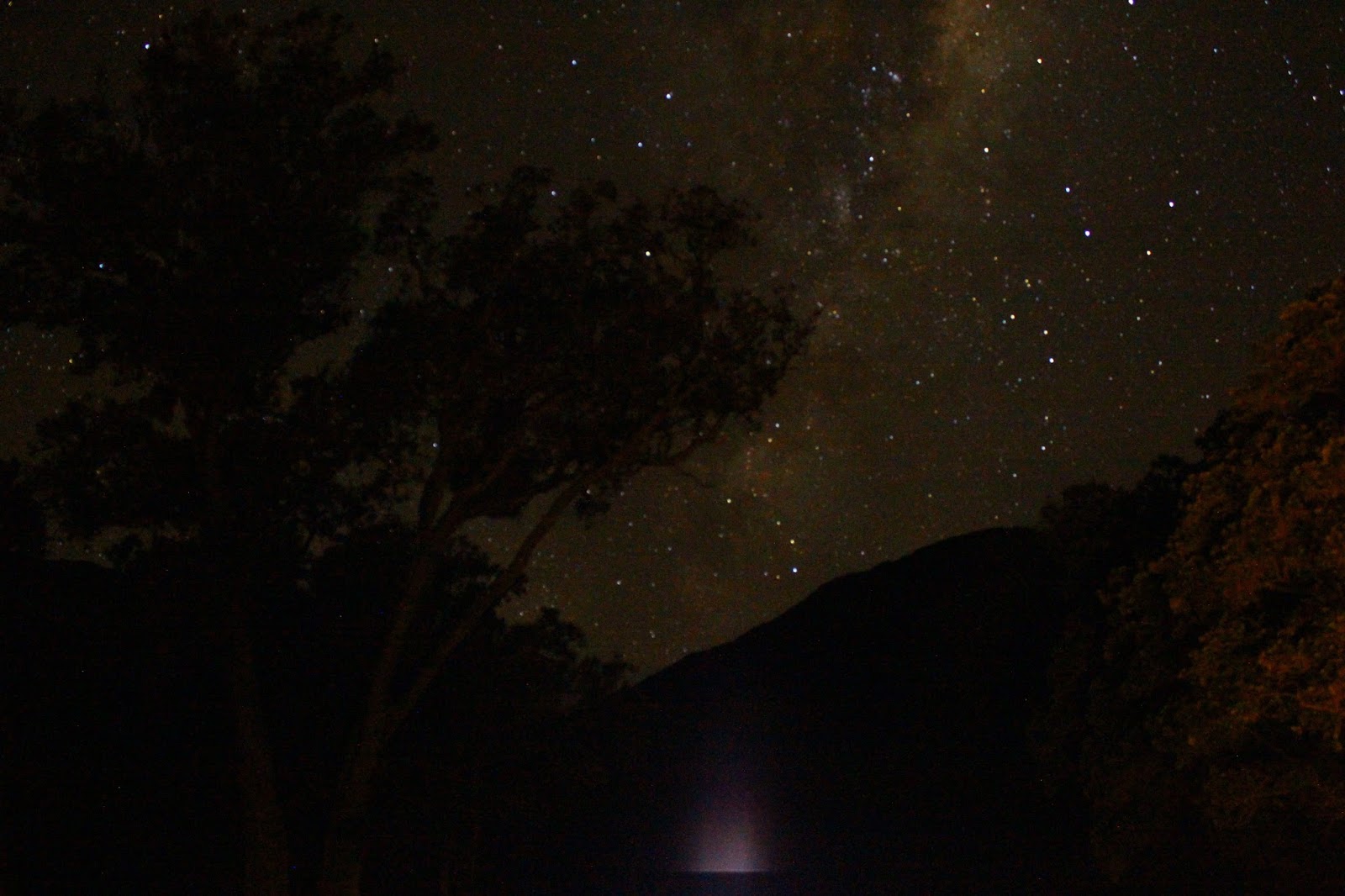
Dark skies on a clear night at last! The Milky Way above the Coromandel (and a flashlight on in the foreground).
Even on "vacation" I'm finding astronomy everywhere! This was an astronomy B&B we found while driving through the Coromandel. They're closed for winter, but one of the owners still took time to show me around. I'd love to come back and stay another time!
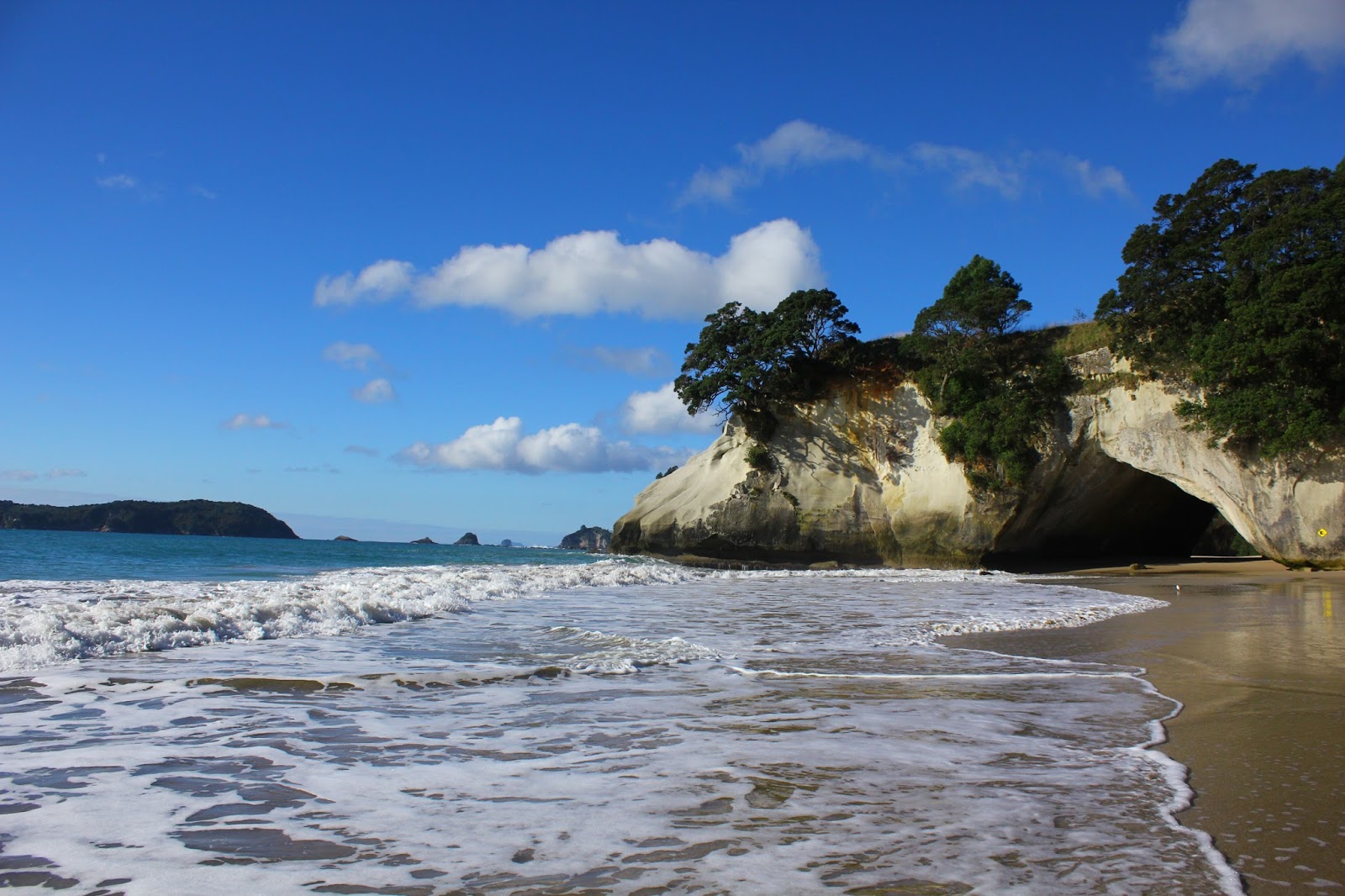
Cathedral Cove, Coromandel Peninsula
Now it's off to Greece for my final Watson adventure!! Huge and special thanks to the Hadfield family (no relation to astronaut Chris Hadfield) in Auckland who hosted me and allowed me to house-sit their beautiful and cozy home while they traveled. It's been so nice to have a sunny and welcoming place to settle for a few weeks!


Wednesday, July 3, 2013

North Island Adventures

Yet again, I've let my travels get ahead of me, and I'm way behind in blogging updates. Since I last checked in, I've launched from Wellington and have been exploring astronomy education around the North Island. I'm now settled in Auckland, New Zealand's largest city and home to 1/3 of the country's population. There's been a lot to explore, and I've learned a ton in a short amount of time.

The main theme of June has been Matariki, the celebration of the Maori New Year. Matariki itself is the constellation I know better as the Pleiades, and it's rising in the morning sky just before sunrise is one of the markers of the new year. There are other indicators of the new year in the stars, as well as the sea, but I'll discuss that later on.

From Wellington, I stopped first in Napier along the North Island's east coast. Although Napier is best known for its vineyards and art deco buildings, it also houses a small planetarium and astronomical society. The planetarium is run by Gary Sparks who is passionate about getting the word of astronomy and space exploration out to young people in New Zealand.
Napier vineyards
With Gary, I observed two schools visiting the planetarium. The first was a "community school," for students currently suspended or expelled from their regular schools. The most interesting question from that group came from one young man who asked what would happen if you punched someone in zero gravity (we had just watched a video called "AstroSmiles" about the everyday tasks on the space station). The next day, students visited from the local Waldorf school, and they also had their fair share of interesting questions including, "What's the most unusual thing that exists in outer space?" and "Are there any strange phenomena we can see at night?" Much more abstract than the standard aliens/black holes/shooting star questions that I hear over and over again.
Gary Sparks of the Napier Planetarium

Theater room of the Napier Planetarium. It's an older building, and the technology isn't as up-to-date, but the Napier Planetarium still has the power to inspire young people about the wonders of astronomy.

From Napier, I went to Tauranga/Mount Maunganui along the Bay of Plenty to meet with Jack Thatcher, who recently returned from a waka (canoe) voyage around the Pacific Ocean. His group sails immense distances around the Pacific using only traditional Maori navigation techniques, including observations of the stars and their movements. I joined Jack and some members of the community early in the morning for a Matariki celebration.

I learned from Jack that the New Year is marked not only by the helical rising of the constellation Matariki in the morning sky, but also by the new moon, the orientation of the Milky Way on the horizon in the early morning, as well as other indicators of winter such as tides and weather patterns. The official beginning of the Matariki celebrations was June 10, and on this morning I joined Jack and other members of the community for a walk up to the top of Mount Maunganui to try and spot Matariki itself. It was cloudy, but the sentiment behind the 5am walk was the same -- to ring in the New Year and reflect on the year past. It was a beautiful event, and I feel grateful for being welcomed to it.
Early morning walk to the top of Mount Maunganui to ring in the Maori New Year.
After sunrise, Jack then showed me around and spoke with me further about his voyages and the knowledge they hope to pass down about the movements of the stars and seas to younger Maori generations. Jack showed me a "Star Compass" he created which divides the sky into different regions where different stars are positioned. At the center of the compass, it is as if you're in the waka, and the posts mark the edge of the horizon. Located at the shore in Tauranga, Jack uses it as an educational tool to teach crew members and others in the community about navigational techniques.
Jack Thatcher (right) with one of his crewmates from Rapanui in front of the Star Compass which you can see as white posts in the background. 

From Tauranga, I went further east along the Bay of Plenty to Whakatane, where I met with the local astronomical society. Their facilities are wonderful, with two larger telescopes and a teaching room for school groups and larger meetings as well. And even with the town of Whakatane just at the base of the hill, the Milky Way and Magellanic clouds are clear in their dark night skies. Coming from the east coast of the US, where dark skies are disappearing rapidly, I have been really impressed by the consistently dark skies in New Zealand. Even in Auckland, if you drive 30 miles out from the city, there are skies dark enough to see the Milky Way in detail.

While in Whakatane, I also met with Gloria Witheford who travels around the North Island with her Starlab inflatable planetarium. She was visiting area primary schools, and I was able to tag along to her shows, which included some information about Matariki. Her main focus is to show a bit of the night sky in the planetarium in the hopes that kids will later go outside at night and experience the skies for themselves.
Gloria Witheford and her Starlab Planetarium.
In addition to traveling around and learning about astronomy education on the North Island, I've also been taking time to explore and appreciate New Zealand's natural beauty. This truly is a stunning place.
View of Mount Maunganui, Bay of Plenty. I think this is my favorite place I've been to in NZ so far. The town of Mount Maunganui is a long strip with water on either side, ending in the Mount as sort of the point of an exclamation mark.

Waterfront in Whakatane, Bay of Plenty
View from hills above Whakatane, Bay of Plenty.
Rotorua, known for its geothermal activity. There are tons of natural hotpools and hot springs all over the Rotorua area.
Creek and Waterfall fed by geothermal lake. (Went swimming here.)
I'm now in Auckland, with only two weeks left to go in New Zealand and 5 weeks left of Watson! I mentioned it briefly in my last post, but to finish off the year, I'll be traveling to Greece to attend the International Olympiad of Astronomy and Astrophysics. I'll be acting as a volunteer journalist for the Olympiad as well as being an additional adult support person for the New Zealand team, whom I met in Wellington (photo below). It should be a great culmination to my year, as I will be speaking with many young people passionate about astronomy.
Team of high school students to represent New Zealand at the International Olympiad of Astronomy and Astrophysics in Volos, Greece later this month. This is just one of dozens of teams that will travel from around the world to display their knowledge as well as learn more about astronomy in ancient and modern contexts. 
Updates on my Auckland adventures coming soon!

Monday, June 3, 2013

New Zealand Updates, pt II

Better get this update out before too much else happens!

I arrived in Wellington just over three weeks ago, and again have accomplished a lot in a very short amount of time, mostly due to the wonderful and welcoming astronomy education community in New Zealand.

My first stop in Wellington was the Carter Observatory, located at the top of Wellington's hilly botanical gardens. Carter, which was once a functioning observatory, now houses an astronomy museum and planetarium. It's a small space, but it covers absolutely all of the bases. There are exhibits on standard astronomy -- the history of the Universe, galaxies, stars, black holes, planets, etc. -- as well as space travel and the ISS, local New Zealand professional astronomy, and Maori astronomy, which is incorporated into just about every exhibit. The planetarium is also New Zealand-centric, with some shows and graphics specifically designed and illustrated to incorporate Maori legends into modern astronomy. By far, Carter is the most holistic and inclusive local astornomy education center I've seen, and the kids I saw running around were clearly having a blast.

Carter Observatory, Wellington
Sun exhibit including a Maori legend about warrior Maui taming the Sun. In this interactive exhibit, you, too can pull back on the great Sun, Te Ra. Carter Observatory, Wellington.

Exhibit about the Big Bang (right) in parallel with Maori creation story (left). Carter Observatory, Wellington.
International Space Station Exhibit. Carter Observatory, Wellington.
Later in the week, I met up with Ron Fisher, who runs his own portable planetarium business called the Cosmodome. With Ron, I saw hundreds of kids ages 5-11 interact with astronomy, and learned that within the context of the Cosmodome, they found the following things most interesting:

1. Seeing how stars connected into constellations and seeing the constellation figures appear on top.
2. Zooming in on certain objects in the sky. Especially planets. Especially Saturn.
3. Seeing how the moon changes shape and position from night to night.
4. Watching time speed up and the stars move around us.
5. Traveling "through the Universe" with a short clip Ron had with images of galaxies.

On a few occasions, I did some follow-up with classes after their Cosmodome session, and the students were often antsy with questions and ideas. I realized from their enthusiasm that the point of a place like a planetarium is not so much the teaching of information, but instead more about the experience itself. Since the kids are young, and it's hard to teach scientific facts in a short amount of time, I don't believe that kids can really learn science in a setting like the Cosmodome. Instead, the stories they hear and the things they see can ignite an interest in astronomy that will allow them to persue and develop an interest in astronomy afterwards.
Inside the Cosmodome, looking at Matariki (the Pleiades) which marks the Maori New Year.
After a week in Wellington, I took a short trip back to the South Island to Nelson, a small town that's doing big things with astronomy education. A lot of this starts with Jenny Pollock, a secondary science teacher who is developing an Earth and Space Science curriculum that is starting to be used nation-wide. I sat in on a few of her astronomy classes at Nelson Girls College, and spoke with the students about what they're learning in Jenny's class. They were especially curious about black holes and the evolution of stars. 

While in Nelson, I also made a few trips to Victory Primary School to meet with Stirling Chatham, better known by his students as "Mr. Science." Stirling works with students in all grade levels, teaching science with fun, interactive and hands-on projects. In addition to his regular activities, including slime-making and using a bird puppet called Einstein to explain science to younger kids, together we had some conversations with his students about astronomy. Stirling filmed some of the conversations, and I hope to be able edit and upload them soon so I can post them here.

My crush on Victory Primary School became apparent to all within an hour of my arrival. I'm finding that I'm learning a lot in New Zealand mainly by seeing schools and systems that work. Victory is a clear example of this. I'm not saying that the school is without issues or difficult students, but instead it is obvious that they are taking an "all hands on deck" approach to education. Victory is extremely community and family oriented, and recognizes and works with every child's strengths and needs. It was refreshing to see this holistic approach to education in a very diverse community as well, with 1/3 of the students recent immigrants mostly from Southeast Asia, 1/3 of Maori/Pasifika origin and 1/3 of European-New Zealand origin. The communal enthusiasm for learning and working together is felt all over the school, from the classrooms to the playground to the joyous and warm staff room. It was a pleasure to work with them, and I learned a lot from a school that leads by such a positive example.

Kids at Victory Primary School drawing the Universe.
Gorgeous Nelson sunset
After a few days in Nelson, I made it back to Wellington, this time taking the Interislander Ferry, catching some gorgeous views of the Marlborough Sounds and the Cook Straight.
Cook Straight Interislander Ferry ride.
In the past week in Wellington, I've met even more educators and adults doing wonderful things in astronomy education. Chris Monigatti is a science teacher at Tawa College just north of Wellington, and has established an astronomy club at his school. He is also training four students to participate in the International Olympiad of Astronomy and Astrophysics, which will take place in Greece this July. (I'm actually trying to go myself as a sort of Watson culmination. Stay tuned.) 

Helping Chris with the Olympiad students is Haritina Mogosanu, a voraciously passionate astronomy educator and "Star-yteller." Although she is not a professional astronomer herself, it's clear that Hari is passionate about spreading the wonders of astronomy with children and adults alike, and using it as a tool to unite people and show a shared humanity that exists in stories of our Universe.

I also met with Marilyn Head, who was actually my first point of contact in New Zealand when I was beginning the Watson application over two years ago. Marilyn, too, does not work directly in astronomy, but has been a driving force in the astronomy education community in New Zealand for a long time, acting as the NZ point of contact for IYA2009 and taking on many independent astronomy projects in her free time. One of these projects was her Galaxy publication, an astronomy magazine for kids complete with cartoon strips, puzzles and projects.

Marilyn Head with a stack of Galaxy astronomy mags for kids.
 Also this week, I visited the Te Papa National Museum, and learned more about the national history and culture of New Zealand. It's a stunning museum, with lots to explore from art and music to history to earth sciences. I managed to cover most of it in a day, but it would be great to go back and explore more.

Yesterday, I made a trip out to Stonehenge Aotearoa in the Wairarapa with Chris Monigatti from Tawa College. Only 90 minutes away from Wellington, this stone circle celebrates astronomy in antiquity and explores the intersections between astronomical cultures globally. It was a stunning sight and clearly a labor of love. I learned a lot from listening to creator Richard Hall give a tour of the stone circle and tell stories of its origins and contexts in the Southern Hemisphere.

Stonehenge, Aotearoa
In front of Stonehenge, Aotearoa with creator Richard Hall.
In case you haven't noticed this trend by now, I'm realizing more and more that my project is in fact more about adults and less about children. Children, remarkably, are proving to be fairly constant from place to place. Their foundation of knowledge and the stories they know related to astronomy are obviously dependent on location, culture and educational circumstance. However, regardless of where I've been, children have extremely similar questions, curiosities and insights. In this way, it's the adults I've learned the most from. It's the creative educators, scientists and global thinkers that have taught me the most important lessons from this year. It is through their guidance and their experience that I am learning to become a more effective and inspiring astronomy educator. 

This week, I'll leave Wellington and continue my travels around the North Island. It will be sad to say goodbye to this gorgeous, hilly city on the water, especially since I've been staying in such a cozy and wonderful home (actually with my friend Jaime who I met in running club in Nepal!). I know it's time to leave, though, and continue to see more. 
Lovely Wellington.
Thanks for reading, and I hope to be able to update more regularly!