Thursday, March 7, 2013

South Africa Cross-Country Trip Part II

[See Part I for tales of the first stage of this journey. This is going to be a long post, with a lot of info and not as many pictures as I would have liked. Apologies.] 

The second part of my trip differed from the first in that I went from creating my own schedule and methods of outreach to visiting many established centers of astronomy and science education. With Case's philosophy in mind about going back to the basics for effective science education, I kept a running total of places where technology obviously made a huge impact, and places where great amounts of learning occurred without the help of modern technology.

Stop 5: Durban (but really, just Gateway Mall)
I planned to be in Durban for a few days, but as other plans developed and as my time became more and more limited, I decided I had to cut my time in Durban down to a mere 24 hours, just enough time to see the fabulous KZN Science Center

The center is located in Gateway Mall, supposedly the largest mall in South Africa. It's an interesting location for a science center, as they're able to make science education an option for people who might not be seeking it independently. Parents can drop off their kids to play and learn while they go and do their shopping in peace, for example. In addition to reaching the general public this way, the science center also regularly hosts school groups and has a team that brings materials and activities out to rural areas.

When I visited the center, there were no school groups scheduled, and the staff was generous enough to take me through their astronomy program. The program is still in its developmental stages, and it was cool to see what they were building and also offer some feedback based on my own experiences. The center has labs and classrooms in addition to an open area for exhibits, so there are a variety of ways to engage with students. They also have an inflatable planetarium with a pre-recorded show (created by NASA, by the way) which they sometimes take out into the mall for public outreach and advertisement. Technology: 1, Basics: 0. 

Just like when I visited the Cape Town Science Center, I was again reminded how much I love these kinds of "informal education" settings. Having the space to play while still learning science and critical thinking skills is something essential that these spaces offer and classrooms often cannot.

Stops 6(a, b, c): "The Fishbowl" in Mtunzini, Unizul Science Center in Richards Bay & Sibusiso Esihle Science Centre in Mvelabusha

Part of my reason for leaving Durban early was because I was offered a ride to and a place to stay by Derek Fish, director of the Unizul Science Center in Richards Bay. He and his family were generous enough to host me for 4 days in Mtunzini, just south of Richards Bay, at their home, known best by guests as "the Fishbowl."

Derek is often described as the "heart" or the "king" of South African science centers. After seeing his center in Richards Bay, its clear why. The Unizul Science Center is unlike others in that it is only for school groups and does not generate its income from the general public. Beyond hosting school groups during the day, the center additionally does school visits, and offers workshops for students studying for their high school graduation exams. 

Unizul Science Center, Richards Bay
Building an an annalemic sundial at a nearby school in Richards Bay with Unizul Science Center Staff
The science center runs on a very small budget, mostly supplied by the University of Zululand (Unizul), and Derek is using that budget to create resources for the greatest number of children possible. He said to me, "If I had an option of creating a good, high-tech activity for one kid or a more cost effective activity for 10 kids, I would choose the second one every time." With this mentality, you can see where the success of this center comes from. Many things in the center are made from recycled goods and many exhibits are "hand-me-downs" from larger centers around the world. While this means that the exhibits look a bit run-down, or "well-loved," kids don't seem to notice or care. +1 for Basics. Technology: 1, Basics: 1.

Some science centers find their success from huge budgets and large floor space (see my experience in Johannesburg below), but this one thrives without those things. What makes this center is not computer screens or flashy interactive video games or shiny new exhibits, but instead people like Derek who bring science to life. And you can see that it works. Watching these kids enjoy the science show and being led through the activities on the floor, you could tell that they were learning and simultaneously having a great time. 

The next day, I went with Derek to Mvelabusha, a very rural area several hours north of Richards Bay, that was celebrating the grand opening of the Sibusiso Esihle Science Center. The Science Center was small -- just a single room converted from the town's old tavern -- but was filled with potential. For now, they're borrowing exhibits from the South African Agency for Science and Technology Advancement, but hopefully more permanent exhibits can be purchased soon. 

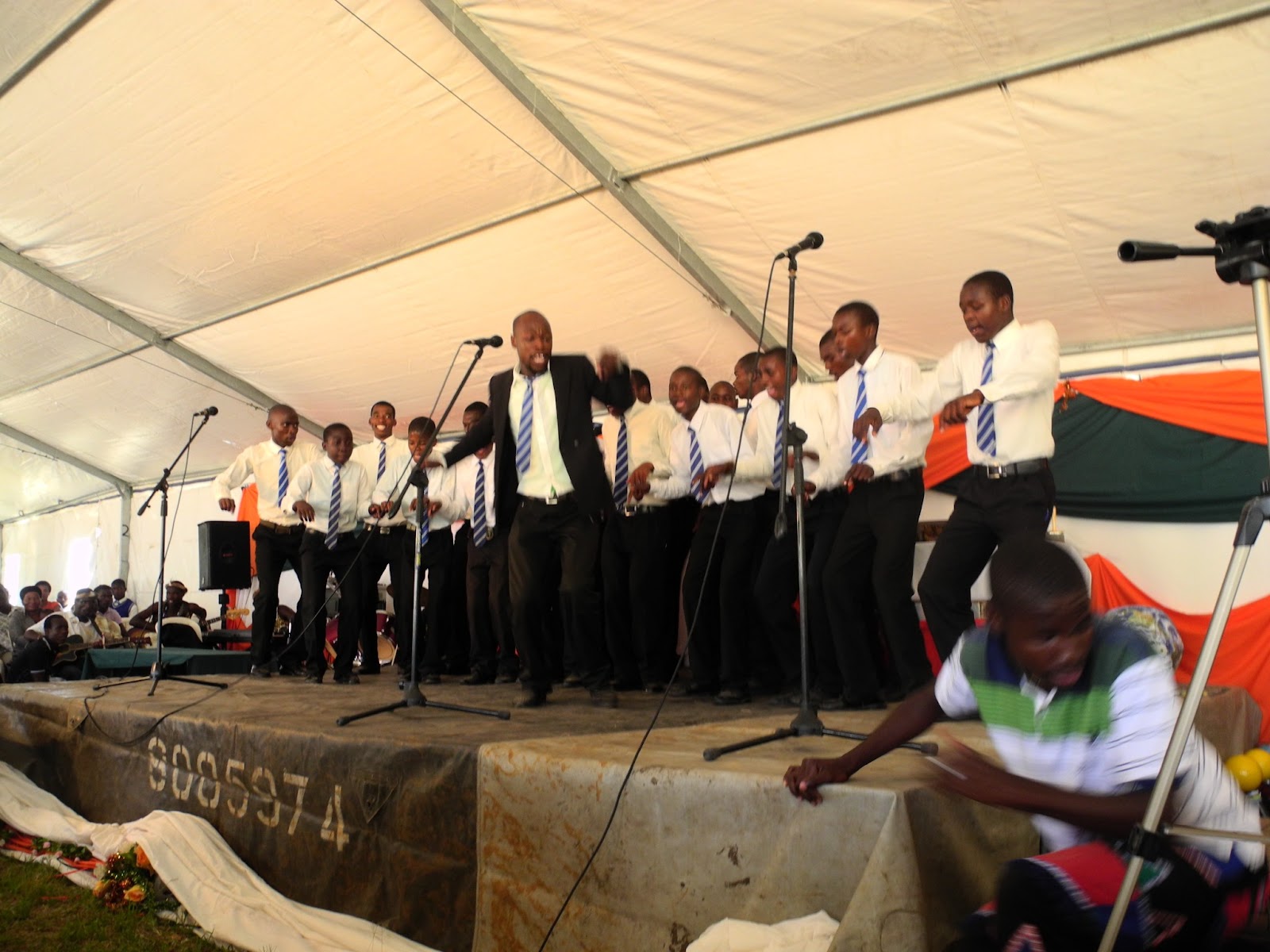
The opening event attracted local government officials, educators, and students from over a dozen nearby schools. The event included numerous speeches, performances by school groups, Derek's famous science show on the physics of sound, and even a talk by a REAL AMERICAN ASTRONOMER (me, incidentally). 
High school boys choir performing at the opening of the Sibusiso Esihle Science Center in Mvelabusha
Student dance performance
Science show by Derek Fish on the physics of sound, translated into Zulu
A talk by an American astronomer (me), translated into Zulu
Again, while this center didn't have too much in the way of material goods, you could tell that the heart and dedication of the people there will be what makes this space thrive as an educational and inspirational space.  +1 for Basics. Technology:1, Basics: 2.

The rest of the weekend was spent with the Fish family, who generously showed me around the lovely Mtunzini beaches and nearby forests. It was a wonderful weekend, and I am so grateful for their hospitality!

Thank you to the Fish family for hosting me in Mtunzini!
Stop 7: Johannesburg, etc.
I spent my final few days of this trip in Johannesburg, described to me either as a"big, bad, dirty city" or as "the greatest city on Earth." I don't think I was there long enough to make a clear judgement either way, but I was able to see most of what they have to offer in terms of science education. Most of my activities were organized by the science awareness sector of SAASTA (South African Agency for Science and Technology Advancement), based at the Johannesburg Observatory. 

The first day, we took a trip out to Hammanskraal, a rural community several hours away from Jo'burg. We arrived late, preventing us from doing a full program, but I did have the chance to have conversations with students about astronomy. While the students were enthusiastic to chat about astronomy, their prior knowledge was practically nonexistent. Even though they were in grades 11 and 12, they often described stars as "fixed points of light in the sky, only created at night" and planets as "the layers protecting Earth" or "where life exists." One student, when asked how many moons the Earth had, said "About 6? Full, half, crescent..." So while they're making observations about the Universe, they have not received formal education on, nor been pushed to think critically about astronomy.

The presence of the inflatable planetarium and later on the telescopes for our star party attracted hoards and hoards of people from the community. While they might not have had any previous knowledge about the object we showed them, the community members were still enthralled by the experience of looking though the telescope. In this way, the technology itself was the attraction and the inspiration.  +1 for Technology. Technology: 2, Basics: 2.
Star party with the Hamanskraal community (it's hard to take out a camera without  teenagers wanting to pose)
The following day, we went to Science Unlimited, a three-day science festival in Johannesburg. I was only there for a few hours, and there weren't very many astronomy-related exhibits, but it was still interesting to see how kids were responding to the science shows, lectures and exhibits. Basic puzzles and science projects were enough to unite students from different schools and have them collaborate to solve science problems together. No screens needed.  +1 for Basics. Technology: 2, Basics: 3.
Science Unlimited festival , Johannesburg
Science Unlimited festival, Johannesburg
In my last full day in Jo'burg, I visited the Johannesburg Planetarium, which was hosting a school group for an interactive lesson. During the show, they used the technological capabilities of the Planetarium to explain scale sizes, seasons and space travel in ways that were easily digestible while still being scientifically correct. 
Johannesburg Planetarium

This year, I have been confronted with several examples of poorly-taught astronomy, most commonly related to scale size. Because the Solar System is so big, and so full of empty space, it's easy to discount scale size when teaching astronomy. There are countless bad examples and only a few good examples that show scale size well. Distances to scale are even more difficult to explain. What I liked about the Planetarium was the ability to show both size and distance to scale correctly so that kids could fully grasp these concepts. +1 for Technology. Technology: 3, Basics: 3.

After the Planetarium, I spent the afternoon at the SciBono Science Center, which was perhaps the complete and polar opposite of Unizul. Everything in the 5-story science center was brand new, shiny and often electronic. There were tons of interactive games ranging in topics from gravity on other planets to the science of soccer.  I can't lie, it was awesome. Transporting virtually into outer space or pretending to fly a fighter jet were really fun, while still being educational. +1 for Technology. Technology: 4, Basics: 3But without any concrete evidence, its hard to say if kids actually learn more or learn better with the help of technology like this. 

SciBono Science Ccenter , Johannesburg

In the flight simulator at the SciBono Science Center, Johannesburg
Final count: Basics: 3 , Technology: 4. But considering the fact that spending less money is always better, this adds 1 to Basics and making the REAL final score a tie at Basics: 3, Technology: 4. This leaves me utterly undecided on the issue.  Feedback/opinions welcome -- I'd be interested to know what people think. 

What's up next: a little more time in Cape Town, SciFest in Grahamstown, and then off to ETHIOPIA later on in March!

Tuesday, March 5, 2013

South Africa Cross Country Trip Part I

I've been back in Cape Town now for a few days, and am still processing this grand and wonderful adventure. For the past two weeks, I've traveled across South Africa (see map from previous post), chatting with kids and educators, visiting schools, science centers, planetariums and observatories. I've learned so much that I think I'll need to divide my account of this journey into two posts.

First Stop: Wilderness
Known for its gorgeous forests and long white sand beaches, Wilderness is home not just to stunning landscapes and wildlife, but also to Case Rijsdijk, one of the original astronomy educators in South Africa. Among his many accomplishments, Case pioneered the Science Education Initiative (SEI) at the South African Astronomical Observatory (SAAO), developed the "Friends of the Universe" program that included a traveling StarBus which took materials and activities to remote areas, and is a regular contributor to South Africa's annual SciFest (which I'll be attending next week!).

During my day in Wilderness, I spoke with Case about his experiences in astronomy education, and he showed me many of the resources that he developed in his time at the SAAO. He is best known for creating highly educational and interactive activities out of very basic materials (see his famous article "Doing it Without Electrons: Innovative Resources for Promoting Astronomy and Science in a Developing Country"). One of my favorite activities prompted students to calculate the distance to Alpha Centauri to an order of magnitude using only a piece of paper with a greased spot in the middle, a light bulb, and the inverse square law.

Working with Case, I was challenged to go back to the basics and think outside of my notions of needing technology for kids to learn science effectively. What can kids build to teach themselves science? How, as educators, can we help them do that? In an age where skills like computer programming are becoming more and more valued, how can we use easily accessible and affordable materials to teach the same critical thinking skills that can then be applied to huge machines later on?

I'm glad that I stopped here first, as these were questions that inspired my thinking for the duration of this trip.
With Case Rijsdijk, highly experienced astronomy educator, in front of the Wilderness wilderness.
The stunning and never-ending Wilderness beach
Stop 2: Day off in Storms River
The following day, I continued along the Garden Route to Storms River, best known by tourists as home to the world's tallest bungee jump bridge. Obviously, I did not attempt that one. I recall a certain project in Ms. Winkler's AP physics class tying a Barbie doll to rubber bands and dropping her from the top of the Blake High School spiral staircase to measure the spring coefficient of said rubber bands. Watching Barbie's head collide with the ground several times made me vow to never bungee jump myself.

In any case, I did spend my time in Storm River taking a day "off" from astronomy education and appreciating the fantastic beauty of the area. I went for a hike in the national park with some women staying at my hostel, and we encountered this phenomenal waterfall directly facing the sea. Video proof of me not being too wimpy and doing something slightly adventurous (sorry its sideways):


I was also in Storms River as asteroid DA14 passed by Earth within the orbits of our geosynchronous satellites. However, clouds came between me and the asteroid and I was not able to observe it as it passed. Luckily, a few hours later, the clouds passed, and I was able to see the magnificent skies of Storms River. Thanks to the SAAO and the OAD, I took this trip with a Celestron FirstScope Telescope -- a lightweight, 3"-aperture, table-top Dobsonion with up to 75x magnification. This telescope is much better than the Galileoscope I traveled with before, and if I ever invest in a small 'scope, this will be the one.
Again, my camera is not much to write home about, but here you can see the Southern Cross above a window at my hostel and some minor details of the Milky Way.

Stop 3: A mandatory overnight in Port Elizabeth
This stop is hardly worth mentioning except for the fact that I took out the trusty telescope again and made friends with some sound engineers from Cape Town by showing them Jupiter and the Orion Nebula. Despite Port Elizabeth being the 14th largest city in South Africa (with a population size comparable to that of Madison, Wisconsin), the skies were surprisingly clear and the Milky Way was still visible. This is different from the east coast of the US where the lights from the cities and suburbs spill out such that there are hardly any places left to see the Milky Way.

Stop 4: Bulungula
I'd heard about Bulungula separately from several different friends in South Africa, with one person even saying, "It's my favorite place in the world. Not in South Africa, not in Africa. The world." So how could I not go?

The link is provided, but in summary, the Bulungula Lodge was created with the Nqileni village and its people in mind. The founders of the lodge wanted to create economic opportunities for people in this tiny seaside village on the Wild Coast without damaging or changing their way of life. The result is this wonderful lodge that is fully incorporated into village life. As a sign in the lodge said, "You are not a guest of the Bulungula lodge, but of the Nqileni Village." The village itself owns 40% of the lodge and is constantly creating new programs for the visitors, including guided hikes, tours, fishing lessons and so on.

I was only there for two nights, unfortunately, and didn't get to do as much as I would have liked. I had time enough just to explore the area myself and take a quick unstructured hike with another lodge guest following only the coastline and a very savvy Labrador retriever.
Duduma the dog, great companion, and excellent guide
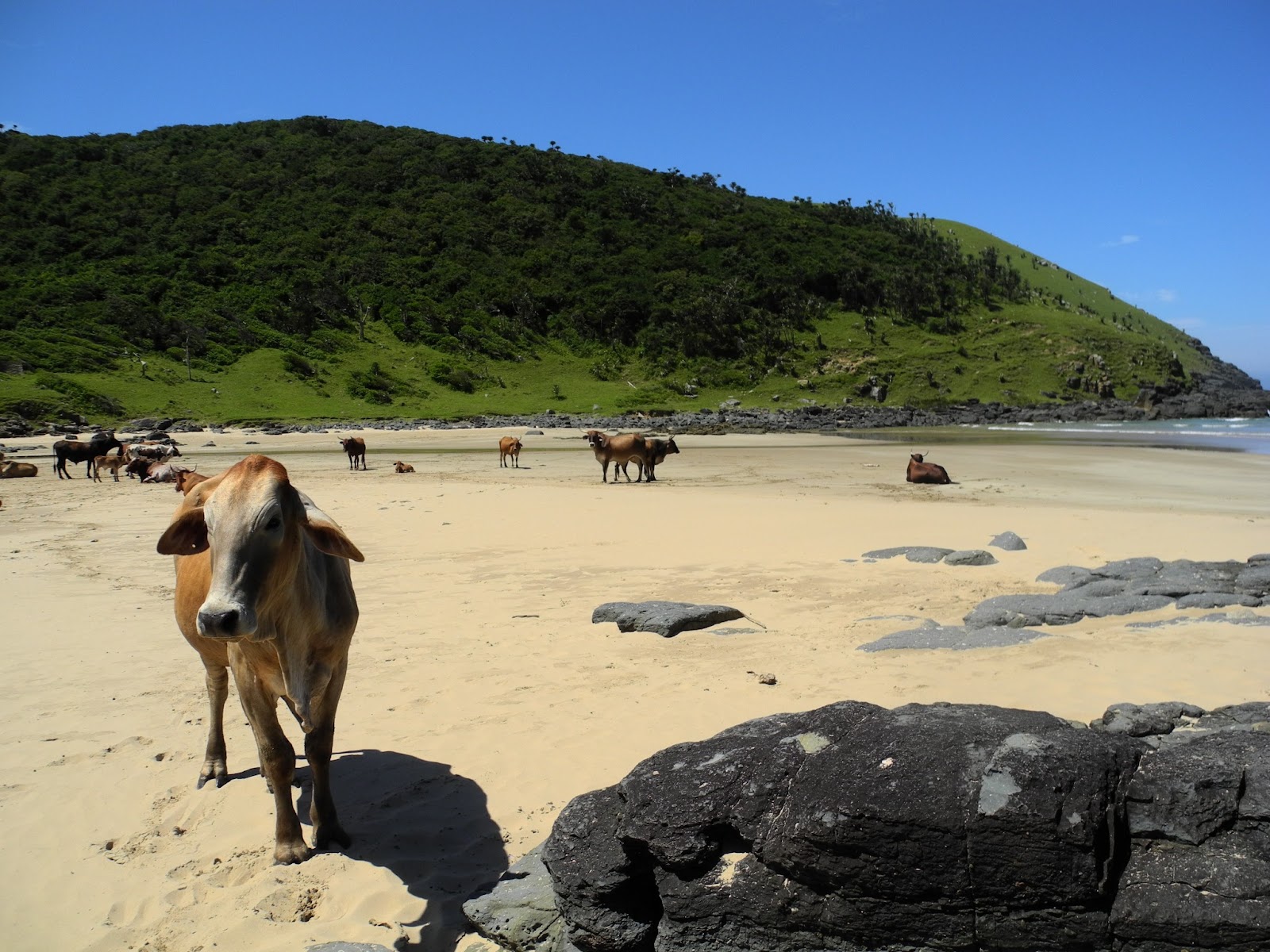
Secluded beach occupied only by cows

Bulungula at sunset

The highlight of my time in Bulungula was the day that I took out the 'scope while tons of kids were hanging around the lodge after school. Since it was daytime, we could only observe the moon and some far-away trees, but the kids still found it exciting, I think. Another short clip:

While not many of them understood English, and I absolutely could not understand their Xhosa, we managed just by pointing and looking and giggling. After a while, they also became interested in the telescope itself and started looking into the telescope at the mirror inside, which, of course, induced more giggling. It was a surreal moment, being with these kids, watching them watch the moon, and having flashbacks to writing my Watson proposal when moments like these were just in my imagination.
* -- * -- *

That's it for Part I. Stay tuned for Part II: Durban, Richards Bay and Johannesburg, in which little Maya learns about astronomy education from people working at some of the greatest science education centers in South Africa. 

Wednesday, February 13, 2013

Right now, now-now, just now, later

One of the first lessons that I had to learn when I got to Cape Town was that when someone says "I'll be there just now" they don't mean "now." Sometimes, they don't even mean "soon." Instead, that phrase is reserved for some time floating in the undesignated future. Meanwhile "now-now," which sounds to my untrained American ear as "immediately," is actually referring to some time soon-ish, usually before "just now."

Now that I understand these non-intuitive phrases, they're actually proving to be quite useful as I balance actively doing my project in Cape Town (RIGHT now), organizing the rest of my time in South Africa (now-now), planning the second half of my Watson (just now), and starting to brainstorm what I want my life to look like after August (later).

Right Now in Cape Town:
This past month, I've gone on a few school visits around Cape Town, giving my usual interactive talk and engaging with kids in my standard way. I've seen a variety of schools in several neighborhoods with varying resources and school infrastructures as well as a diversity of student populations.


All of the schools I've visited are "public," but most schools still charge fees, and the school decides how high the fees are. In some ways, it reminds me of my home in Montgomery County, Maryland, where there is a wide range of public schools, in a variety of neighborhoods. The difference is that schools in the Bethesda/Chevy Chase area are still technically free and therefore the same cost as schools in Silver Spring or Wheaton, even though they have more resources and typically nicer facilities. In Cape Town, you can clearly see the differences those higher schools fees make, with smaller class sizes, more resources, after-school clubs and so on.


In addition to school visits, I'm attempting to also think outside the box, and engage with kids in more informal settings. In my original Watson proposal, I envisioned times when I would chat with kids and families in public parks and not always need the formal educational structure of schools. In Chile and Nepal, lack of green spaces, language barrier, and my own uncertainties prevented this from happening. In South Africa, I have no excuses, and feel determined to follow through and make it work.

So, this past weekend, I went with some friends and a bag full of crafts and supplies to Green Point Park, my favorite urban park in Cape Town. When my mom was here, we were amazed by this expansive, intricate, and inclusive park. We joked that it looked a little like Sesame Street, with kids from all backgrounds playing and working together.


As a first attempt, it worked fairly well. Some kids came over, and while painting a rocket or planet on their face, we'd talk about what they knew about astronomy. Usually they said things like "the moon is made of cheese," (it is, right?) but sometimes other spurts of creativity and imagination came out. I'm hoping to do this at least once more before leaving Cape Town, improving with more time and better quality face paint.


Last week, I also visited the Cape Town Planetarium and Cape Town Science Center, reminding me how much I adore these types of informal education spaces. I hope later on to go back and observe how they work with visiting school groups to see what the experience is like for kids.
Standing on the Western Cape in the Cape Town Science Center.
Now-now: My trip across South Africa
Tomorrow I'll leave for a cross-country, multi-city, solo adventure around South Africa, visiting planetariums and observatories in large cities, but also stopping in small towns and hopefully hosting small star parties and perhaps visiting schools. The route will look something like this:


While I'll miss the routine and community I have in Cape town, I'm looking forward to a change of pace and the chance to explore this country through the lens of my project.

Just Now: Watson Ahead
The latest and greatest update is that I've officially added Ethiopia to my project list. I'll be going just for a short three week visit from late March to early April. Who knows why, but I've always wanted to travel to Ethiopia. (I credit the Ethiopian community in the D.C. area as well as the Ethiopian art in my grandparents house.) They have a burgeoning observatory and professional astronomy community there, and as a consequence, outreach is continuing to grow. I'm looking forward to exploring a very different part of Africa and learning how astronomy education is developing there.

After Ethiopia, I'll be back in Cape Town briefly, hopefully with a quick jaunt to up Namibia for a week (stay tuned). Then, in mid April, I'll finally push off to New Zealand. As I've cut into my time there dramatically, I'm working to plan my time there as best I can to make it as productive as possible.

Later: Post-Watson thoughts?
This area of planning is still very open, very theoretical, and very far away, as far as I'm concerned. My project, though, is making me think more and more about my life after August. I am certain in my passion for using astronomy to make the world a better place, but this is so open-ended and my path to making that happen could go many many ways. Should I pursue a higher degree in astronomy? Should I instead think of studying global education? National education policies? Science communication?

One of the many wonderful things about working with the Office of Astronomy for Development has been being mentored by Kevin Govender, who is so generous with his time and sharing his infinite wisdom on these matters (usually in exchange for a loaf of freshly baked bread). For now, he's advised me to consider not what I want to be, or what I want to do, but instead what I want to learn, and taking it from there. I'm hoping for some time to reflect on that fantastic advice as I spend the next weeks in buses, seeing this country and reflecting on my time here.

As always, thanks for reading! If you have any, comments are always greatly appreciated.

Sunday, February 3, 2013

QR2


February 1 marked the halfway mark of this amazing Watson year. It's hard to believe how quickly time is moving and simultaneously how packed my time has been with activity and adventure. Below are the contents of my second Quarterly Report, submitted to Watson HQ. It was challenging to write about everything that I've seen and done since November, but hopefully I struck a balance between not writing too much and also not oversimplifying my experiences. 

Part I: Nepal
I intended to write the first half of this quarterly report six weeks ago, when I first arrived in South Africa and my thoughts and reflections of my time in Nepal were fresh. I knew that if I waited to write about my time in Nepal until now, that challenging and intensely rewarding eight weeks would fade and become smaller and less significant in my memory. Alas, with the Watson as it is, I broke this promise to myself and must report on my time in Nepal as I recall it now.
            When I last checked in, I was about to start working with a volunteer program teaching young kids in a Buddhist monastery. I debated whether or not volunteering was the best course of action for realizing my project in Nepal. On the one hand, this kind of organization and structure would give me access to kids for my project without the delay of building contacts. But, on the other hand, the volunteer program was much more expensive than the cost of living in Nepal, and it wasn’t too clear to me where the money would go. After a lot of thought, I decided to go for it. I was in Nepal to engage with kids from very different religious backgrounds than my own, and I felt that I could gain something special by living and working in a Buddhist monastery. Luckily, the organization I went through, Volunteer Initiatives Nepal, proved to be a wonderful organization, and I was happy to support them.
            This did not mean that my time in Nepal went smoothly and as planned, of course. I’m embarrassed to admit this, but my vision of life in a monastery was of stereotypical peacefulness and tranquillity. I assumed the kids that lived there would be shy and introspective, with mentors who helped them to become composed and self-aware. This could not have been further from the truth. With about 80 boys ages 3 to 16, and only a few older men to supervise them, these kids turned out to be quite a handful.
It was my job to teach four classes of English every morning. My plan was to incorporate themes of astronomy into my lessons during my 3-4 weeks there and then to speak with kids about astronomy during mealtimes or other casual settings that would naturally arise from living together. Language barrier and lack of interest prevented this from happening, and I quickly had to change my plan and find different ways to accomplish my larger project goals elsewhere in Kathmandu and Nepal.
Connecting with astronomer, educator and founder of the Nepal Astronomical Society, Sudeep Neupane, almost instantly changed my life in Kathmandu for the better. After meeting him, my new routine consisted of teaching in the monastery every morning, and going to schools around Kathmandu with him every afternoon. At the monastery, while I wasn’t able to focus on astronomy, I was, without a doubt, becoming a much better educator. Teaching those kids six days a week gave me a crash course in classroom management, lesson planning, improvisation, and resourcefulness. I learned to let conversations of astronomy arise less frequently, but more organically, usually triggered by my space-themed accessories or from the growing rumour of my being a scientist. Meanwhile, my afternoons in schools allowed me to engage with the original goals of my project. In less than a month, I visited almost a dozen schools and interacted with hundreds of kids.
From my time in the monastery and my time in schools, I feel like I got a good understanding of kids’ general ideas about astronomy as well as the educational culture in Nepal. Here are a few observations I made (again, I do not aim to generalize about all of Nepal, but these are rather patterns I observed):
1.      I found an emphasis on repetition and memorization in most Nepali classrooms. Students were mostly being taught to regurgitate answers as opposed to being encouraged to ask questions or work through problems. This meant that I often got cookie-cutter answers to my questions (e.g. “A star is a heavenly body made of gas”).
2.      No matter which school I went to, there seemed to always be at least one student, regardless of grade level, location or school ranking, who was obsessed with astronomy. These students would ask questions about black holes, the curvature of space-time, dark matter, quasars, and the Big Bang – topics I didn’t learn about until college. While these enthusiasts were from various backgrounds and geographical areas, the one commonality I did notice between them was their gender. I don’t doubt that there were girls who were interested in astronomy, but I think the historically patriarchal culture in Nepal made it such that girls remained quiet. These astro-loving boys tended to dominate the conversation, answering every question, raising their hand constantly. Later on, I learned to ask students for written responses so I could gauge the interest and knowledge of an entire class, not just the few enthusiasts.    
3.      I went to Nepal specifically to investigate how religion impacts children’s beliefs about astronomy. During my time there, I learned not just about Buddhist religion in the monastery, but also about Hindu traditions and Sanskrit astronomy. Regardless of the religion itself, I observed that, for most kids, being religious was more ritualistic and less spiritual. Going through the daily pujas did not necessarily imply that they were thinking about their meanings. In Sanskrit astronomy, celestial objects are worshipped and prayed to as gods, and it is believed that the movement of these objects in the sky will have an impact on your personal fortune. Children participate in these rituals, while simultaneously learning in school that these same celestial objects are planets and stars made of rock and gas. When I asked the students about this, they didn’t seem too preoccupied with any possible contradiction. They mostly said they didn’t think about it much, and just did as they were instructed, (again, emphasizing point 1). Some students were naturally critical thinkers and told me decisively that one or the other was correct, but this was rare.
After finishing my month in the monastery, I had 3 weeks to explore and be a “free agent” in Nepal. I took time to travel around the country, see different landscapes and engage with students in different places. I did this either independently or with Sudeep’s help and endless connections. Highlights from that time include going to a traditional Nepali wedding in a tiny and remote village, spending a week traveling and visiting schools in Pokhora, a lovely lakeside town, and passing down my small telescope to a physics teacher in a village school that was beginning to introduce science into the high school curriculum.
            I’m so grateful to have had the opportunity to learn about Nepal and its rich history and culture, as well as for the chance to do what I’m passionate about in a very different environment than what I’m used to. However, by the end of my eight weeks there, I was tired -- mostly physically tired from noise, pollution, regular food illness and the general chaos of Kathmandu, but also emotionally and culturally tired from the language barrier, clear gender inequalities, and idealization of me as a white North American.  These discomforts challenged me and pushed me to grow and adapt more rapidly than I ever have, which was simultaneously extremely rewarding and extremely exhausting. By mid-December, I was ready to move on to South Africa for a change of pace, change of weather, and change of schedule.

Part II: South Africa
            By the time I arrived in South Africa, I was craving summer, the ocean, the mountains, English speakers, and some time with family. I was lucky enough to have my mom visit me for a week, and with her, I got into the swing of things in Cape Town. It was nice, even just for a short period of time, to have someone that knows me really well by my side to help me process everything that was going on, both with my Watson and with things back home.
South Africa is renowned for its astounding efforts in astronomy education. There are many well-funded, well-established programs here that aim to educate the public about astronomy. The South African government in particular has made science education, and astronomy education especially, a priority in this country. There are several major scientific institutions here, including the South African Astronomical Observatory (SAAO), home to the Southern African Large Telescope, which is the largest telescope in the Southern Hemisphere. South Africa will also soon be home to a majority of the Square Kilometre Array, the world’s largest system of radio telescopes. The difference, however, between these institutions and the large telescopes I visited in Chile, is the clear emphasis on education and outreach. My goal in South Africa is to see how astronomy is reaching children in a plurality of communities in this very racially and socioeconomically diverse place.
            I’m currently based at the SAAO in Cape Town, visiting schools and tagging along to many outreach projects. I’m also working with the International Astronomical Union’s Office of Astronomy for Development, an office designed to “use astronomy to make the world a better place.” With the OAD, I’m learning about many global astronomy education projects, and developing resources both for myself, and for other educators who may want them in the future.
            I’m finding myself to feel comfortable and at home in Cape Town, with a house at the observatory, a local frisbee team, many friends and lots of time to explore and enjoy this lovely city. I’m feeling settled, which I suppose means that it will soon be time for me to move on.
I’m now in the process of planning a two-week, cross-country trip across South Africa to science centres, schools and planetariums.  It will hopefully be an action-packed, astronomy-and-kid-filled adventure, and I’m looking forward to seeing more of this country.

Part III: Looking ahead
            Now that I’m at the halfway point, I feel restricted only by time. There’s so much that I want to do, and I feel I have the resources and the confidence to do it. Working with people here in Cape Town has given me a global network of ideas and contacts that could help facilitate my project anywhere I go. Now it’s just going to be about decision-making and maximizing of time and resources.
            I plan to add Ethiopia to my list of countries, and go there for just a short, three-week visit to schools and small observatories near the capital. It would be a less complete experience than in the other countries I’ve been to, but I think if it’s well planned, I could get a lot of out of it. Then I’ll come quickly back to Cape Town, gather my items, say some inevitably difficult goodbyes, and head out to New Zealand by mid-April. I’m looking forward to all of it and taking in the challenges and adventures as they come.
            As always, thank you Watson HQ for this amazing opportunity and your endless support! 

Monday, January 21, 2013

Sutherland

Last week I had the opportunity to spend a few days in Sutherland, a small town in South Africa's Northern Cape and home to the South African Astronomical Observatory (SAAO) and the Southern African Large Telescocpe (SALT). I was able to both spend time at the observatory to see the telescopes, as well as get a full tour of town to visit schools and talk with local students.

I love how there's something common between all of the observatories I've visited, independent of  global location. Whether in Chile this past year, or in Arizona or Hawai'i before that, all of the observatories I've seen have this refreshing combination of tranquility from the natural world and exciting, cutting-edge technologies that have the potential to make ground-breaking discoveries nightly. Sutherland was no different in that regard, and in a way, arriving at the SAAO felt like I was returning to something comforting and familiar.
The SALT telescope with Orion above.

What's different about Sutherland, however, is a clear and intentional link from the observatory to the people in the neighboring community. For example, at the observatory site itself, there's a "community dome" halfway up the hill between the visitors center and the big telescopes. This open-roof geodesic is meant for all people to come and observe the stunning Sutherland night sky. The inclusion of the community also extends beyond the observatory site and into the town through projects from the SALT Collateral Benefits Program (SCBP). More on that in a minute, but first, a bit about the town of Sutherland.
Community dome with SALT in the background.
Sutherland is a small rural town in the Northern Cape known for its its sheep farming, the occasional snow and its clear night skies. Fifteen years ago, Sutherland received only a few dozen visitors per month, but since the inauguration of SALT in 2005, tourism has boomed in Sutherland, with over 13,000 visitors annually. This brought in outsiders from the tourism industry, leading to a creation of multiple astronomy-themed guest houses, restaurants, and tourism agencies. This has indeed boosted the economy of Sutherland, but problems such as unemployment, alcoholism and low levels of education still plague the small town, and remnants of apartheid are still shockingly visible.
The town of Sutherland
An example of an astro-themed site in town
On Wednesday, I got a tour of Sutherland and had the opportunity to see the many projects funded by the SALT Collateral Benefits Program designed to address these remaining problems. My tour guides, Willem and Anthony are both from Sutherland originally. Anthony is now the Sutherland manager for the SALT Collateral Benefits Program and Willem is one of the tour guides of the observatory. Through them, I learned about Sutherland's history, its current realities, and how the observatory is fitting in.
My Sutherland hosts and tour guides, Willem (left) and Anthony (right)
The biggest and most holistic project from the SCBP I saw was the Sutherland Community Development Center, equipped with 25 computers, free WiFi and printing, a small library, a study area with individual desks and a kids play area. This center provides a free and safe space for kids to do their homework, adults to use the internet to look for jobs or take online courses, and a place where people can come together for community meetings or gatherings. The idea and plan for the community center came out of extensive meetings with members of the community who expressed what they wanted for Sutherland. In this way, it is a space that is utilized and valued by the people of Sutherland. If the SAAO and National Research Foundation (NRF) had just created a space without any community input, I think it would not have been as successful as it is today.
Sutherland Community Development Center

On Thursday, I spent the day with Willem and Anthony in two of Sutherland's schools to chat with the kids about astronomy. Perhaps because it was the second day of school after summer vacation, or because the kids do not speak English as their first language (Sutherland is a primarily Afrikaans-speaking town), or because I didn't have enough time in the classes for the kids to get to know me, overall participation was low and kids kept quiet.


I did get some ideas from them, and it was clear that some kids were interested in the subject. They all said that they could see many many stars at night, but students were reluctant to say what it was about the stars that appealed to them. Most said they liked to look at the stars because they were pretty and sparkly, but didn't go into depth about that. When I asked where the stars came from or what they're made of, some said dense gases or the Big Bang, while others credited God or Jesus. Two girls came up to me during the break and asked how both answers could be simultaneously true, and I gave my standard diplomatic answer about how part of being an adult and a scientist is being critical of the information you're given and making opinions for yourself. I'll be returning to Sutherland with the UNAWE-South Africa team in February, and so it will be nice to go back and engage with the kids more through activities that may allow them to be more comfortable and open up.


Besides seeing the town, a major highlight of my trip was just hanging around the observatory and seeing the telescopes. Here is a picture with me and the SALT telescope (again, the largest telescope in the Southern Hemisphere!)
On the catwalk of the SALT telescope. With a diameter of 9.8m, this is the largest optical telescope in the Southern Hemisphere
The views of the surrounding hills were stunning, and I was lucky enough to witness some dramatic thunderstorms (lucky for me, not for the astronomers that couldn't observe). I even got a few lightning strikes on camera!
The sunsets in Sutherland were phenomenal. Colors not enhanced.  
Lightning photo number 1

Pseudo-lightning photo with views of the clear skies above. Note the Pleiades in the top left corner.
That's all for now. In the weeks ahead, I'm looking forward to getting into schools around Cape Town and starting to engage with students here. I'm grateful for the opportunity to work with the students in Sutherland, and hope that experience will help me shape future school visits to make them more interactive, comfortable and informative. Special thanks to Willem and Anthony for making this such a wonderful and meaningful trip!

Wednesday, January 9, 2013

The Center of the Astronomy Education Universe


[A long, but unapologetic, photo-light, astro-ed/project- heavy post. You're right, MKC! I shouldn't be apologizing for sharing the details of my project. I am sorry for the many many acronyms, but hopefully I've made them as clear as possible. And for you skimmers out there, feel free to skip to the photos of Cape Town at the end.]]

"Scientific endeavour is not purely utilitarian in its objectives and has important associated cultural and social values. It is also important to maintain a basic competence in "flagship" sciences such as physics and astronomy for cultural reasons. Not to offer them would be to take a negative view of our future - the view that we are a second class nation, chained forever to the treadmill of feeding and clothing ourselves.
-- South African White Paper on Science & Technology,  
Department of Arts, Culture, Science and Technology 
4 September 1996

I've been in Cape Town for just over three weeks now, and have comfortably settled into PHASE THREE of my journey. South Africa, in many ways, is considered to be a mecca for astronomy education in that there are many well-funded, well-established programs that educate the public about astronomy. The excerpt above is one example of how the South African government has made science education, and astronomy education in particular, a priority for the country. The last sentence most clearly articulates this priority -- in order for South Africans to make an impact on today's world, and to become true global citizens, knowledge and ownership of science is imperative.

This national priority is realized through the many South African astronomical centers. The main institution is the South African Astronomical Observatory (SAAO), home to the South African Large Telescope (SALT). SALT is the largest telescope in the southern hemisphere, with a diameter of 9.8m (the largest telescope I saw in Chile was the VLT on Cerro Paranal, which has a diameter of 8.2m). The headquarters of SAAO is in the Cape Town suburb of Observatory (or "Obz" as the locals call it). This is where I'll primarily be living and working while in South Africa. The SALT telescope itself is in the town of Sutherland, about a four hour drive away. I plan to visit Sutherland next month and work with some of the outreach projects that are taking place there.

As the quote above implies, science development is not just for scientists, but also for the benefit of the whole country. Thus, SALT has implemented a Collateral Benefits Plan, which funds education and outreach activities all over South Africa. In the words of former SAAO director, Prof Patricia Whitelock, "When SALT was set up we realized that it would be a huge waste if we simply ran it for the benefit of our international partners." 10% of SALT's budget goes directly towards community projects and outreach, especially in disadvantaged communities.

** THIS IS THE PART THAT I LOVE. ** Not only is South Africa investing in innovative science projects, but they simultaneously see the importance in funding science education. SALT is therefore by South Africa and for South Africa. In Chile, there are dozens of cutting-edge observatories and research projects, but Chileans have limited access to those resources as the observatories are owned and operated by foreign institutions. While SALT has many strong international partners (the US, UK, New Zealand, Germany and Poland), the SALT Collateral Benefits Plan ensures that South Africans are profiting from the major projects on their home soil.

SAAO headquarters in Cape Town also hosts the Office of Astronomy for Development (OAD) of the International Astronomical Union (the IAU, best known for demoting Pluto in 2006). The OAD is specifically designed for "Using astronomy to make the world a better place." In addition to working with SAAO in local outreach projects, I also hope to work with the OAD to learn about astronomy education projects around the world.

The Square Kilometere Array (SKA) is another huge project and point of pride in the South African astronomy community. The SKA, with its headquarters in the UK, will be the most powerful radio observatory in the world when it is completed in 2019. The array will incorporate thousands of radio dishes and antennae spread out over 3000km. The "Square Kilometere" describes the approximate surface area of all of those antennae combined. South Africa recently won the bid for site selection of the SKA, with a majority of the antennae and dishes being built in Southern Africa, and the rest in Australia and New Zealand. While SKA construction won't officially start until 2016, South Africa has already started MeerKAT, a 64-dish array that has now been designated as the pathfinder for the SKA in South Africa. They're doing some cool outreach projects, too, like this comic book:

In addition to these major projects, there are also dozens of science centers and planetariums across South Africa. **ANOTHER GREAT THING** is that everyone works together! The planetarium staff collaborate and share resources with the outreach groups which work with local educators and so on. There are regular meetings of South African EPO (Education and Public Outreach) staff to discuss their current projects and how best to work together. Interestingly enough, this kind of communication and collaboration is fairly very rare, in my experience. In Chile, for example, some outreach groups were funded by Universities, others by North American-funded observatories, others by European observatories. Very rarely was there communication between the different groups. It's refreshing to learn that here ideas and resources are shared.

In the coming days, I'll be getting settled in at SAAO and carving out how I'll fit into these many wonderful, pre-existing programs. I'll also be thinking about projects that I want to do independently. After three weeks of a "vacation" without anything project related, I definitely feel ready to get moving again on the project.

These three weeks have been wonderful, though, as I've been able to explore the area, make friends (mostly by playing frisbee), and get settled. I was lucky enough to have my mom over the holidays, and she proved to be the best travel and adventure companion for exploring this amazing city. Some pictures:
Exploring Cape Town cuisine with Mom!
Biking through the Cape Winelands
Sunset over the Atlantic Ocean from Signal Hill
The cloudy view from the top of Table Mountain after our Christmas morning hike. 
Penguin-watching at Boulder's beach
Thanks for reading! SAAO has let me borrow a computer for my time here, so I hope to be writing and updating more often. That means I'll be more contactable by email, but you can also send SNAIL MAIL to:

Maya Barlev
Office of Astronomy for Development (OAD)
South African Astronomical Observatory
P.O. Box 9
Observatory
7935
South Africa